Thanks go out to everyone for a great year.
I hope you all have a safe and culturally enriched break.
I look forward to seeing you about the studio next year!!!
You can collect your TEXT based works NOW - they are placed in a BOX at the staff door.
I will also post the PDF of the complete works here!
Your essays will be available once marks are released. (I am really impressed by the quality of writing thus far!!!)
All the best,
Amanda.
Tuesday, November 9, 2010

photos of the suitcase project are up on facbeook
Join: "I can SPI higher then a pigeon cause you are the wind beneath my wings"
to have a looksie the photos
http://www.facebook.com/group.php?gid=123447664360407
to have a looksie the photos
http://www.facebook.com/group.php?gid=123447664360407
Wednesday, November 3, 2010
Presentation Overview
Orlan prescribing herself as a Carnal Artist acts upon her own body by abstracting the image of it and going against nature by opposing it and the conventions that exercise constraint on the human body. She also goes against society in her alterations by questioning whether are self representations conform to an inner reality or whether they are actually fabricated for marketing purposes, in the media and society at large especially in the conventions affiliated with beauty. In her work she goes against the idea of ‘God’ in the biblical sense, transforming the body into a language “the flesh made word” as opposed to the word made flesh. Orlan uses her body as a vessel, and she detachs herself as a personality from it.
Orlan through her work modifiys the body, she alters her image commenting on the aesthetics of beauty in society and this can be seen in her nine performative operations acting as a portraits of a potential future of humanity. Orlan detaches herself from her body and responds to the potential in technology enhancing and evolving the body by going against nature’s limitations. She perceives the acceptance of one’s natural self to be a primitive concept, given the technology of our time, and therefore does not believe that nature must be abided.
Orlan has undergone nine operations to remake her appearance commenting on the varying types of beauty which is not necessarily prescribed by the media, and the series as a whole is entitled The Reincarnation of Saint Orlan (this in reference to another art work of Orlan’s entitled Saint Orlan) or Image-New Images. Of the operations performed so far, one altered her mouth to imitate that of François Boucher's Europa; another an appropriation of the forehead of Leonardo da Vinci's Mona Lisa; and another imitates the chin of Botticelli's Venus. These models were chosen for their mythical and symbolic connotations as well as their beauty. Venus was chosen for fertility and that being symbolic of sexuality and beauty and "Europa because she looked to another continent, permitting herself to be carried away into an unknown future” . Yet another surgery, the widely publicized "Omniprésence," November of 1993, implanted protrusions in her forehead to mimic the protruding brow of Mona Lisa. the end result was two symmetrical horns.
In the plastic surgery operations/performances Orlan deals with the problem of dissection, peeling, and unveiling which feminist theorists have critiqued as masochistic compared to the sexual sadism of the anatomist's ruthless penetration -- the thrust of the male creator. But her work is also a task of incorporating the image of goddesses from mythology and art history -- such as Leonardo Da Vinci's "Mona Lisa" and the goddess Diana -- as a computerized process of hybridization. Orlan explains: "...I devised my self-portrait using a computer to combine and make a hybrid of representations of goddesses from Greek mythology. I chose them not for the cannons of beauty they are supposed to represent, but rather on account of the stories associated with them. Diana was chosen because she refuses to submit to the gods or to men, she is active and even aggressive...(Goode, 1997)”
Orlan through her work modifiys the body, she alters her image commenting on the aesthetics of beauty in society and this can be seen in her nine performative operations acting as a portraits of a potential future of humanity. Orlan detaches herself from her body and responds to the potential in technology enhancing and evolving the body by going against nature’s limitations. She perceives the acceptance of one’s natural self to be a primitive concept, given the technology of our time, and therefore does not believe that nature must be abided.
Orlan has undergone nine operations to remake her appearance commenting on the varying types of beauty which is not necessarily prescribed by the media, and the series as a whole is entitled The Reincarnation of Saint Orlan (this in reference to another art work of Orlan’s entitled Saint Orlan) or Image-New Images. Of the operations performed so far, one altered her mouth to imitate that of François Boucher's Europa; another an appropriation of the forehead of Leonardo da Vinci's Mona Lisa; and another imitates the chin of Botticelli's Venus. These models were chosen for their mythical and symbolic connotations as well as their beauty. Venus was chosen for fertility and that being symbolic of sexuality and beauty and "Europa because she looked to another continent, permitting herself to be carried away into an unknown future” . Yet another surgery, the widely publicized "Omniprésence," November of 1993, implanted protrusions in her forehead to mimic the protruding brow of Mona Lisa. the end result was two symmetrical horns.
In the plastic surgery operations/performances Orlan deals with the problem of dissection, peeling, and unveiling which feminist theorists have critiqued as masochistic compared to the sexual sadism of the anatomist's ruthless penetration -- the thrust of the male creator. But her work is also a task of incorporating the image of goddesses from mythology and art history -- such as Leonardo Da Vinci's "Mona Lisa" and the goddess Diana -- as a computerized process of hybridization. Orlan explains: "...I devised my self-portrait using a computer to combine and make a hybrid of representations of goddesses from Greek mythology. I chose them not for the cannons of beauty they are supposed to represent, but rather on account of the stories associated with them. Diana was chosen because she refuses to submit to the gods or to men, she is active and even aggressive...(Goode, 1997)”
Tuesday, November 2, 2010
Art and Institutions – Candida Hofer

Hofer photographs interiors of art institutions architecture denoting the presence of the institution without the presence of people, this presents the museums without vitality. Hofer’s work relates to the fact that the importance of housing irreplaceable work is privy to the fact that art and ideas remain alive because they cannot be separated by the themes and reasons to which they are created to begin with. It draws attention to the focus on institutions and what they consider to be treasure. This is a notion towards the possibilities of art’s past and art’s future and the way art is reliant on the people and themes of the time that create the art.
Art and Audience – Vanessa Beecroft


Beecroft presents large groups of naked, semi-naked, or swimsuit clad women which resemble a high-fashion photoshoot. It creates a voyeuristic level of behaviour in the audience which brings attention to the ornamental portrayal of women in the media and also the way women are perceived in society. In reverse, she also depicts groups of men clad in military uniforms and aligned in military formations. The men are reversely depicted to the women as being anything but vulnerable and strong.
The performance invites the audience to observe and view them, but not to interact with them, it reduces them to a role of inadequacy in relation to the performers physical and behavioural perfection.
The performance invites the audience to observe and view them, but not to interact with them, it reduces them to a role of inadequacy in relation to the performers physical and behavioural perfection.
Art and Architecture – Bodys Isek Kingelez

Kingelez’s work evokes a progression from modernism’s depictions of cityscapes which zoom forward to portrayals of fantastical designs of future cities. Displayed like architectural models which resemble buildings from New York, Paris etc they are created out of recycled materials, such as bottle caps, tubes, corrugated cardboard, tinfoil etc. These works relate not only to architecture but also to globalisation bringing attention to the fact that a lot of the first world’s waste often becomes building materials of the third world’s housing.
Art and Globalisation - Chen Zhen

Chinese artist, Chen Zen’s installation comprises of Western and Eastern influences and exposure of religion and political opposition. The work Daily Incantations comprises of Chinese chamber pots that are arranged in an array of Buddhist bells, centred by a conglomerated pile of residue of electrical and electronic objects. These objects portray cultural differences. Also featured is a sound system which has recordings from the artists childhood of the reading of Mao’s Red Book from the Chinese Cultural Revolution. The human waste and industrial waste illustrate cultural difference between Western materialism and Communist indoctrination.
Zhen is suggesting that changes that have resulted due to globalisation and technology are apparent to all notions of politics and culture. The integration of these factors into his work suggests a collision of eastern and western worlds histories and futures.
I had a lot of difficulty with this topic I didn’t want to reference obvious artists (Olafur Eliasson and Laib Wolfgang,) but couldn’t find/think of any other artist’s that fitted within the topic. I think I had so much difficulty with this topic because I couldn’t push past the connection to religion that spirituality has. When I researched the definition of spirituality it provided me with some sense of clarity, an understanding as to why I couldn’t find an artist that represents spirituality. The reason being that, spirituality is in fact unattainable we can experience it but we cannot contain it, thus It is impossible for artists to truly represent spirituality. My difficulty may also lie within my inability to see something that is spiritual from another persons percpective, as i feel that spirituality is an individual's experience. So instead of finding artwork's i googled some natural phenomena's which i think are pretty amazing.
Various definitions:
-Spirituality is the level to which one is able to see past there own self.
- The ability to tap into areas of life beyond what is normal (what is able to be easily seen, heard, felt, and smelt)
-Spirituality is often experienced as a source of inspiration or orientation in life. It can encompass belief in immaterial realities or experiences of the immanent or transcendent nature of the world


Various definitions:
-Spirituality is the level to which one is able to see past there own self.
- The ability to tap into areas of life beyond what is normal (what is able to be easily seen, heard, felt, and smelt)
-Spirituality is often experienced as a source of inspiration or orientation in life. It can encompass belief in immaterial realities or experiences of the immanent or transcendent nature of the world


Monday, November 1, 2010
Art & Audience
I feel that this topic ‘Art & Audience’ is the most obvious and off the most importance, as art’s purpose is to be seen. Whether the audience is simply the artist who creates the work; the general public; or other artists. The artists Intention is to provide audiences with a different perception in relation to various situations and life in general.
The artist:
- Challenge’s > perception; values; beliefs; opinions
AND
- Trigger’s > thought; memory; and emotion;
Artist Derrick Haung held a residency at SCA this year for two week’s he’s really lovely and showed me some of the works he had previously created and exhibited. Derrick’s works are primarily interactive installations and sometimes include a performative aspect, fitting perfectly within the topic ‘art & audience’. His work frequently incorporates a sensory aspect, through the use of dried popori; fruit; and leaves which the audience is unable to ignore. Derrick uses both visual and sensory aspects within his work that enable the audience to fully interact and become immersed. “Another kind of aromas” exists as a darkened room containing a low rectangular container, filled with dried organic material free to touch, and a variety of hand packaged spices hanging neatly and freely on the walls. The packages and the material within the open box are beautifully illuminated by light. “Hidden Place” is within a small exhibition space, filed with dried leaves and warm lighting, central to the space is a cylindrical-like structure reminiscent of netting used to keep away insects, and pieces of loose thread which hang freely around the structure like cobwebs or roots. The structure is large enough for a person to stand; sit; or lie within it. The warm lighting and dried leaves evoke the sense of being within nature, and the netting seems to take me a step back in time, triggering memories of building cubby houses with pegs and sheets as a child, pretending I was elsewhere. “Consumption” was a performative work in which Derrick sat within a space filled with red cotton waste, peeling the rinds off oranges in which he then latter re-sowed together. How I interpritate this work in relationship to it’s title and the repetitive action in which Derrick performs, is essentially a statement concerning the overwhelming consumption of food. The loose orange peels represent the waste of produce and the sewing-together is then perhaps is a direction to recycle and reuse.

"Another kind of aromas" spices, box, documents, 2007

"Hidden Place" textiles, threads, leaves, light, 2005

"Consumption" oranges, red thread, 2005
I think Derrick’s work is beautiful and I’m a little bit jealous, I absolutely love the use of organic and deteriorating material, evoking the sensors, and mentally and physically recreating a space elsewhere. I hope you all got to meet him.
Sunday, October 31, 2010
Art and Globalisation - JR


Watch this fantastic video for the details of his work:
http://www.mutualart.com/OpenArticle/Meet-the-TED-Prize-Winner-of--100-000--T/87F68DF44529C7F2?utm_source=newsletter_b&utm_medium=email&utm_campaign=nl_video
Art and Architecture - Hundertwasser
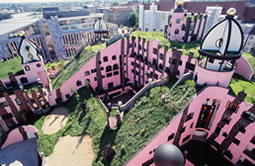
The Green Citadel of Magdeburg, Germany (2002 - 2005)

Waldspirale (Forest Spiral), Darmstadt, German (built 1990)
Hundertwasser is one of my favorite artists involved in architecture, for his strong philosophies and environment thoughts. For example, he believes it is better to walk on uneven floors and doesn't see why the windows on a building should be all aligned. A common feature of his work is that he despises the straight line, and so many of his building as asymmetrical. Some of his most famous buildings are Blumau, Kunsthaus Wien, Spittelau, 21st Century Clock and Mop Incinerator, Osaka. The most recent building have been built based on plans that Hundertwasser designed before his death in 2000. Grüne Zitadelle Von Madgeburg in German and The Ronald McDonald House in Essen, Germany are two examples of this. His philosophy embraces human existence in harmony with nature and aesthetics of life and art. He has written manifestoes in relation to architecture: Mouldiness Manifesto against rationalism in Architecture, Window Dictatorship and Window Rights, and There are No Evils of Nature - There are Only Evils of Man.
"Since his first artistic actions his thoughts circulate around the same topics: life, nature and all beauty, what happens between, next to function and profit. It attracts attention that the texts were cumulative subdivided, more targeted and gets more profoundness by and by. They obey not the trends, the rumour of the public and the exchange value, they owe their appearance the diligently and exact study of humans and their manifold interdependences and addictions, necessities and opportunities, but also their lapses… "
Walter Schurian, in: Friedensreich Hundertwasser, Schöne Wege, Gedanken über Kunst und Leben [Beautiful Paths, Thoughts on Art and Life] Writings 1943 - 1999, Munich 2004 (translation from German)
http://www.hundertwasser.de/english/texts/philosophie.php
Thursday, October 28, 2010
Art and the audience
 vb46.017Los angeles, 2001 Vanessa Beecroft
Vanessa Beecroft organises these large groups of naked female models who perform within the gallery space for up to three hours. This work in particular the women are standing as if they are posing for a high fashion photoshoot, wearing nothing but stiletto heals. This image of the nude women isnt really that shocking because there is a barrier that has been created between the audience and performance. However, this work is almost animated by the presence of the audience within this room of nude bodies that are not interactive, therefore this work becomes this dramatic spectacle when there are people in the room to witness it, to feel perhaps awkward or uncomfortable in the room with these models. To me it also almost seems like the artist is making some sort of comment about the portrayal of models coming off production lines and how these women are presented as objects almost as opposed to human beings. i think this work really needs to be witnessed to have the dramatic effect that the artist has intended upon.
Wednesday, October 27, 2010
Art and Politics

Thomas Hirschhorns work is usually laced with political statements and signs. He applies a makeshift aesthetic using very basic techniques and materials such as; box tape, cardboard, and aluminum foil. He was part of a group of graphic designers called Grapus which was a political design firm running throughout the 70s to the 90s.
His installations for me have a protest feel to them, he makes use of newspaper imagery and clippings from popular culture magazines.
Heres some of his work:
http://www.gladstonegallery.com/hirschhorn.asp?id=1405
Art & Audience: Yoko Ono

Yoko Ono, "telephone piece", 2008. Sydney Biennale.
This work consisted only of a telephone which at any point during the exhibition Ono may call from an undisclosed location and an audience member will answer the phone, or not and in that case it just keep ringing. As one would expect.
So, you could argue that the pinicle point in the work it the performative action of the phone being dialled, it ringing and then being answered by a stranger at the other end. The work is the performance, the answerer supposedly enters into this unknowingly that they are actually becoming art at the time of the conversation.
They have the opportunity to speak to the artist from within the gallery and say whatever they want. I think this idea is awesome. And really quite weird.
Art & Politics: Ron English

Ron English, "Abraham Obama", paste-up. 2008.
This is one of my favourite Ron English works. It was created during the 2008 US election. English has combined the faces of Abraham Lincoln and Barrack Obama to form a super democrat. The face of the president who will change "The free world" for the better. And then there's also the Warholic reference, which of course means that English is selling the 'super presidents' as a commodity, advertising, mass producing. Emphasising the the fame and celebrity which American presidents seem to acquire without fail.
Art & architecture: Frank Gehry

Frederick R. Weisman Museum of Art, Designed by Frank Gehry. 1993.
I really like the idea of an art museum being a work of art in it's own right and I really think that this particular building successfully accomplishes this. The abstraction of the design and the reflective surface of the outer material creates an appealing structure in an urban environment. It's unusual and it's intriguing. Makes you wanna look at art...
Tuesday, October 26, 2010
Art & Globalisation: Yoko Inoue

Untitled, 2006. Yoko Inoue. Dimensions vary. Ceramic.
I see this work as a corruption of buddhist ideals. Although these shapes are pleasant enough, they are unmistakably casts of plastic drink bottles. The coin slots reference the keeping and storing of money, want, desire, attachment as well as pollution ( the pollution of the mind, unclarification.). These are the things which keep one from enlightenment. I feel that Inoue is making a comment on the western ideals of mass production and consumerism and how these things effect eastern spirituality. Money spent on water which comes free from a body of H2O.
Art and Politics
I was looking on the Art & About website because I wanted to get some background info on all of the works that I have been seeing lately scattered throughout the city. I was a little surprised to see that almost all of the descriptions of the works on the site were very 'safe', so as not to offend anyone or bring about any sort of commotion, given its status as a public event. I on the other hand find some of the works to be particularly sinister, ironic and political. The colourfully dressed statues all over the city reminded me of Yinka Shonibare's practice of incorporating ethnic patterns within traditional English attire. Because the various fabric used to dress the statues is so vibrant, I seem to associate it with 'native' or 'tribal' imagery. I may be way off the mark with this impression but while others stand in front of the colourful statues in order to have their picture taken, I can't help but feel something like "white guilt" or a tension with the work. Again, with the laneway work HAR BOUR VIEW by John Cambell, the site talks about the work in a very light-hearted, harmless way, seeming to censor the work's political message.
Maurizio cattelan
hello SPIes just wanted to introduce you a crazy crazy crazy crazy artist for those who havnt met him yet. he was the one who exhibited the horse suspended from the ceiling in mca for sydney biennale 2008! italian sculptor Maurizio cattelan (b.1960) has a very satirical yet radical, perhaps even disturbing, style of approaching life and death and everything inbetween. here are some google-searched images of his work


his works are an instant attraction and fascination. but i dont think i can fall in love with them. its just too painful to even get too close up on the screen. crazy crazy artist. here is an interview with Cattelan by michele robecchi http://www.interviewmagazine.com/art/maurizio-cattelan/ slightly long but quite interesting.
check him out!
art and politics (annotated bibliography) - liu bolin
http://www.liubolinart.com/
liu bolin's official website. as his personal website it has very thorough biography and insight into his previous and current works. he's photo gallery is nicely divided into sulpture, photo, oil painting and blackboard which all have very high resolution documentations of his work. the website also contains links to different articles featuring his work as well as a message board which enables people to contact him directly. the photo gallery did not have any description of each works which was quite confusing. and unfortunately for "hiding in the city" photo documentation series i dont think it was the full collection of his series were uploaded. however the cctv footage shots of peoples reaction towards his camouflaged body was documented which is quite interesting. the website couldve been more useful if it contained some academic writings of his practice.
http://whitehotmagazine.com/articles/2008-interview-with-liu-bolin/1245
charles schultz's interview with liu bolin in 2008 (translated by christine wang). Despite most of this interview being about his work China report 2007 and only 7 question short interview it gives enough insight into his experience, ideas, concepts, influence and practice. China report 2007 which i havnt mentioned in my presentation is another very political work of liu bolin. so i could relate the artists ideas presented in this interview into "hiding in the city" series.
http://www.ifa-gallery.com/artists/liubolin/texts.html
ifa-gallery website contains a curator review Everything Is Not Quite Right about liu bolin's practice. written in april 2008 by Bérénice Angrémy it gives short introduction to his persponal life then moves onto Urban Camouflage which talks about his "hiding in the city" works, influence, intentions, aesthetics and concepts very deeply. then moves on to talk about Eyes Blindfolded which explains his more sculptural practices such as "burning mao" and "red hands". as all liu bolin's work has a reference back to chinese politics and government and as this text talks mostly about the artists "hiding in the city" series it was a very helpful site providing more academic writing compared to other sources.
http://www.youtube.com/results?search_query=liu+bolin&aq=f
youtube, as an addition to everything else, was a "must see" source for me in order to understand the process of liu bolin's "hiding in the city" practice. it is not only fascinating but also educational in a sense.
liu bolin's official website. as his personal website it has very thorough biography and insight into his previous and current works. he's photo gallery is nicely divided into sulpture, photo, oil painting and blackboard which all have very high resolution documentations of his work. the website also contains links to different articles featuring his work as well as a message board which enables people to contact him directly. the photo gallery did not have any description of each works which was quite confusing. and unfortunately for "hiding in the city" photo documentation series i dont think it was the full collection of his series were uploaded. however the cctv footage shots of peoples reaction towards his camouflaged body was documented which is quite interesting. the website couldve been more useful if it contained some academic writings of his practice.
http://whitehotmagazine.com/articles/2008-interview-with-liu-bolin/1245
charles schultz's interview with liu bolin in 2008 (translated by christine wang). Despite most of this interview being about his work China report 2007 and only 7 question short interview it gives enough insight into his experience, ideas, concepts, influence and practice. China report 2007 which i havnt mentioned in my presentation is another very political work of liu bolin. so i could relate the artists ideas presented in this interview into "hiding in the city" series.
http://www.ifa-gallery.com/artists/liubolin/texts.html
ifa-gallery website contains a curator review Everything Is Not Quite Right about liu bolin's practice. written in april 2008 by Bérénice Angrémy it gives short introduction to his persponal life then moves onto Urban Camouflage which talks about his "hiding in the city" works, influence, intentions, aesthetics and concepts very deeply. then moves on to talk about Eyes Blindfolded which explains his more sculptural practices such as "burning mao" and "red hands". as all liu bolin's work has a reference back to chinese politics and government and as this text talks mostly about the artists "hiding in the city" series it was a very helpful site providing more academic writing compared to other sources.
http://www.youtube.com/results?search_query=liu+bolin&aq=f
youtube, as an addition to everything else, was a "must see" source for me in order to understand the process of liu bolin's "hiding in the city" practice. it is not only fascinating but also educational in a sense.
art and audience
 still from meechifeber
 keyboard player playing along with film on station
 lady watching one of his films
i found an very interesting artist John Bock that Incorporates art and audience into to his practice by choosing where and how to display his works
in one of his show he choose to display it at central station in Italy on platform 21 where he showed and series of animations and films for people to be able to sit round and enjoy to watch
one of the films was called meechfieber
which is about a German fable set on a alien planet in the country side
i wasn't able to find a video on it
but he had several screen set up round the station like on set on the stair case where people would sit on the steps and watch it
and in the main walkway of the station
here is a video of some of his installations of where he places his works
www.youtube.com/watch?v=intgp3z1GIk&feature=related
Monday, October 25, 2010
Art and Audience

What is inspiring to me especially with art interaction with its audience is how it brings people together, it invites strangers together and encourages people to be creative, to get involved, to think and to do. There is always a fun experience when it comes to interactive artworks because it involves all of us. In Art and Today, I think the work, well all of them in fact not this one specifically, really captures what I am saying "The Sound We Make Together" By Harrell Fletcher a 2003 project took video footage of local groups "who were invited to practice their regular recreational activities". This artwork was made in Texas, and takes particular groups/societies and shows the variety of these groups and makes the audience more aware as well as adding an uplifting element, for everyone who is participating is creating something they are passionate about and sharing it with those who are not only just their peers. What is pictured is Harrell Flecther for in couldn't find stills from the films unfortunately.
Art and Politics

I like the Guerilla Girls, we discussed them in class and what attracts me to them is there gender equalist attitude towards women in the artworld. When it comes to art and politics there is such a wide spectrum, because anything can be turned political, more so then others of course- maybe this a sweeping statement, but anyway the personal interacting with the social, the interpersonal expierience and your knowledge of the world, your social class your race- all this takes part in how you react or how your artwork is perceived. This is kind of relative to the Guerilla Girls, there artworks are specifically gender related. In their artworks there is a use of percentages to respond to the lack of women artists in major galleries and museums. They formed in 1984 which is a huge part of there work for it is reflective of their time, and they use poster like formatt and advertisement to highlight what they stand for; to engage the audience and to take action. No one is left out, in one piece which we dicussed in class, which highlights this, was a poster which asked "what do these artists have in common? (it lists the artists)...they allow their work to be shown in galleries that show no more than 10 percent of women artists or none at all". Whats great about their work is that they have had an impact, because of what was highlighted, institutions "scrambled" to improve their ratings. I personally like the poster "Do women have to be naked to get into the Met Museum", 1989 which is pictured. I like it because sex sells...nah, its because of the information that comes with the work it is shocking and sad that it was a reality in 1989.
Art and Its Institutions


When it comes to art and its institutions its hilarious to see the satirical and comedic work that comes out, especially against high art and its audiences, especially for how much this has changed and how accessible art is today. This is explemfied in Thomas Struth work of his large scale photographs of people at blockbuster mainstream art exhibitions to see the masters. His "lush" imagery depicts famous museums such as the Louvre in Paris, the Metropolitan Museum of Art in New York, and other major Art tourist attractions, which amuses me that the audience is portrayed as the artwork, and indeed the wide spectrum of the audience portrayed, its your average joe blow and your john doe there, or people from the other side of the world, the old institution of art is no longer art maybe, its a tourist attraction, and the real art is something else on the other side of the spectrum, or maybe he is just poking fun at something that is portayed so serious is so accessible to everyone and that you can take a photo inside there and it is an artwork in itself. How he was able to take the photos also intersets me just because normally there is no photography allowed. The photographs also demonstrate the large scale of the artworks and how the audience is "dwarfed" by the piece, the decoration- the architecture comparitive to its audience- how beautiful the atmosphere is compared to the averageness of the audience. His work also demonstrates how institutions shape our perception, how art in the street is perceived and how museums add this air of importance to the work- he highlights this "elitism". What is pictured is the Gallery in Venice, taken in 1992, and the Louvre in Paris taken in 1989.
Art and Architecture

Bodys Isek Kingelez playful take on architecture and design is both engaging and fun to look at. Its childlike and its colourful, there is nothing bleak about it, its like he took grey out of his vocabulary and made rainbow his medium and exploded into a mass of buldings and structures. His work really sells in this way because though it could be arguably garish or kitsch, it is also happy, it makes me happy cities normally look dull and grey and his work is it trying to make as happy does he want a better world, his work is also comprised of recycled materials so he may be interested in bettering the world. His work is modern at the same time, which is what is fascinating to me for I passionately hate new buildings I think they are so uninspired compared to older victorian houses or art deco or even 50's, basically prior 70's I like, and as an artist he has attracted me to modern artichectural dreams, there is definately something old made new, some art deco related structures there but with a modern twist. I think anyone who likes lego and liked making/building lego as a kid or even now would enjoy looking/researching his work. Villa fantome, 1996 is what is pictured.
Art and Globalisation


For Art and Globalisation I have decided to discuss the work of Yinka Shonibare. What interests me about his work, in relation to his headless manniquin figures dressed in Victorian style European costumes, is the theatrical element and the aesthic element, his work linking to fashion and culture which I don't know is his intention, the initial intention is different which I will discuss, but to me I see his work as wearable and a product as well as a piece of work that is a scene and i actually would like to buy the clothing to wear myself, the idea of wearing/advertising the work. What I read in Art and Today is somewhat different to my own reading, which just adds another element, the work Gallantry and Criminal Conversation, 2002, "explores the contradictory fallout of European colonization of Africa", and I believe this is symbolised by the European style dress with the african style fabric/pattern, its a hybrid of the two into an item of clothing, one wearing the other. This idea of hybrid is also explored in the vulgarity/animalistic sexual energy that is coming from the work, all the mannequins participating in a sexual act, maybe that is suggesting that it is human nature to extract, take, make two one, to oppress, to dominate. I think this quote is quite necessary in describing the work taken from Art and Today- "In his work we glimpse both the desire of the dominators to appropriate "otherness" for themselves and the longing of the dominated to adopt the lifestyles of their oppressors"
art audience and biofeedback

This work relies on the breath of the viewers to make virtual jelly fish move on a screen. I find works that touch on the potential of biological feed back fascinating. At the moment these works seem to be in the technical sence in a kinda of infancy, however they are an incredibly potent mechanism for making the viewer aware of the body as a collection of automatic processes. The dialogue between body and space is replaced between body and virtual space or the space created in a virtual sense in the body.
Globalisation

I dont know if I am drawing a very long bow, but it seems since this thing they call globalisation has started to materialise. This thing that was meant to create a flat homogenious mono-cultural world, has some what done away with some of the imperialism that existed as late as the 90's in relation to indigenious and first nation artist. A good example being this years biennale and the works of both Lila Gama the contemporary (Misaso) Papua New Guinean cheiftan and artist.
Perhaps it is a shift that was always going to happen? or perhaps a flat earth can in some ways mean a level playing feild at least in the reception of are being made conteporaneously?
Sunday, October 24, 2010
arthur ganson
Arthur Ganson (b.1955 usa): amazing kinetic sculptor i came across listening to TED.com
he's works are quite musical and gestural as if they are trying to whisper something into your ears. listen to his talk on
http://www.ted.com/talks/arthur_ganson_makes_moving_sculpture.html
he's works are quite musical and gestural as if they are trying to whisper something into your ears. listen to his talk on
http://www.ted.com/talks/arthur_ganson_makes_moving_sculpture.html
art and audience
http://jumpinginartmuseums.blogspot.com/
blogspace JUMPINGINARTMUSEUMS created by Allison Reimus invites people to send in photos of themselves jumping in front of artworks and in art galleries. you should really check this blogspot up, its amazing. people from all around the world have posted their pictures, some hillariously funny some with amazing skills. in Allison Reimus's blogspot profile she writes
I am an avid Art Jumper. Sometimes, while visiting art museums and galleries, I am so excited by what I see that I have to jump for joy.
it is truly great to see people sharing such love for art. the audience role have not only heightened but these photographs have become new artworks themselves.

blogspace JUMPINGINARTMUSEUMS created by Allison Reimus invites people to send in photos of themselves jumping in front of artworks and in art galleries. you should really check this blogspot up, its amazing. people from all around the world have posted their pictures, some hillariously funny some with amazing skills. in Allison Reimus's blogspot profile she writes
I am an avid Art Jumper. Sometimes, while visiting art museums and galleries, I am so excited by what I see that I have to jump for joy.
it is truly great to see people sharing such love for art. the audience role have not only heightened but these photographs have become new artworks themselves.

Art & Political


Christian Boltanski
Art and Polictics, the topic already speaks about the individuals opions, or the world's events, it's interesting how every events or moments can relate to the topic. In fact, that a lot of artist create work based on their personal experience of their childhood, or past. The art and today book, talks about how creating artworks during different periods, was about engaging with the world, and social issues. The artist that I've chosen for this topic is Christian Boltanski.
Christian Boltanski is the one of my favourite artist, because the way he present the work, the art practice speaks about the story or emotions. Boltanski is known as the sculptor, painter, and installation artist. He create works that reflects on the events from the history, such as Halocaust. It's interesting how he is French artist, but because his father is Jewish he shares those memories from the history. I think his work is making the statment that each individuals are important to this world or the Earth, without considering one being poor or famous, its just being human.
Christian Boltanski's series of installation were named with the word 'archives' and 'monument', which the definition it self speaks about the memories and remembering the past. His art practice are based on collecting materials such as, newspaper script, photo, found objects, clothes and so on. When I was reading about his works, it said that the artist himself, doesn't have any detail of the people on the photographs. This idea of making artworks that artist doesn't have any connections with, are pretty, amazing, because their just from the past, whom past away somehow. But through his works, those individuals are remembered and again holds life within the installation.
Overall, I think his sculptural works, are so amazing and beautiful, it will be very thankful if someone in the future remembers me after I die. It's that scary but shows how important we are.
art and its institution - exhibition space
continuing on from the discussion we had in class for nick's presentation on art and audience i would like to discuss about "exhibition space" in relation to week 9's topic Art and its Institution. its interesting how one topic connects to everyting else. Personally i have to admit that i come across more artists and their works online than going to galleries and reading paper. this way i can keep up with new artists rising in iraq and south america with a tap of my finger. internet is what enables the world to communicate, thus globalise. it gives big and not so big yet artists opportunities to update their profiles and portfolios, and often use it as their new medium. there are now various online art galleries and auction sites, educational materials and network. it saves people time and effort. however whether this is all entirely healthy is questionable. i remember reading something on galleries and museums slowly losing their status in society. childrens are losing interest in physical activities and adults are too tired working six days a week. this is so unfortunate because seeing artworks in real life provides a very different experience from seeing it on your computer screen, most of the times. sculpture, performance and installation, especially. and whats the point of creating body of works if its only to be viewed online?
so what i really wanted to say was that we should all go gallery hopping sometime soon.
so what i really wanted to say was that we should all go gallery hopping sometime soon.
art and globalisation - biennale
hello everybody. Im sorry ive been really slack with blogging and its already our last week of 2010! I cant believe we got through this year this quick, its scary. Well im going to get on to some serious blogging so watch out.
First ive got some thoughts on biennale, the contemporary art festival, in relation to week 8's topic art and globalisation.
We've just had our 17TH SYDNEY BIENNALE. Apart from the overloaded MCA i quite enjoyed the works. Our biennale is the fourth oldest in the world since 1973 and probably the biggest international visual art event in sydney, maybe australia. According to the official biennale website, we have so far presented works of 1355 artists from 82 countries with 436,150 visitors attending 2008 sydney biennale. I wonder how much we had this year? To me, this is globalisation. It is an amazing experience to see how artists around the world interpret and create art. And through these works i can recognise the embedded cultural elements that are so similar yet different to one another. Biennale does more than just celebrate contemporary art, it promote international artists and raise awareness about the life around the globe, and upgrade our, the artists and the public's, understanding of art and the world.
globalisation dont only mean that the we, the artists, are influenced by the truth around the world but also that we have an opportunity to communicate back to the world population.
its great.
http://www.bos17.com/page/about_us.html
First ive got some thoughts on biennale, the contemporary art festival, in relation to week 8's topic art and globalisation.
We've just had our 17TH SYDNEY BIENNALE. Apart from the overloaded MCA i quite enjoyed the works. Our biennale is the fourth oldest in the world since 1973 and probably the biggest international visual art event in sydney, maybe australia. According to the official biennale website, we have so far presented works of 1355 artists from 82 countries with 436,150 visitors attending 2008 sydney biennale. I wonder how much we had this year? To me, this is globalisation. It is an amazing experience to see how artists around the world interpret and create art. And through these works i can recognise the embedded cultural elements that are so similar yet different to one another. Biennale does more than just celebrate contemporary art, it promote international artists and raise awareness about the life around the globe, and upgrade our, the artists and the public's, understanding of art and the world.
globalisation dont only mean that the we, the artists, are influenced by the truth around the world but also that we have an opportunity to communicate back to the world population.
its great.
http://www.bos17.com/page/about_us.html
Friday, October 22, 2010

Wednesday, October 20, 2010
The other blog?
Anyone know what the address for the blog that michael made for the processed bassed show was?
Art an spirituality Paul Laffoley

This guy is intense, he paints these huge detailed architectural esoteric diagrams
"his work is usually classified as visionary art or outsider art combine words and imagery to depict a spiritual architecture of explanation, tackling concepts like dimensionality, time travel through hacking relativity, connecting conceptual threads shared by philosophers through the millennia, and theories about the cosmic origins of mankind"
http://en.wikipedia.org/wiki/Paul_Laffoley
I suppose his work is considered outsider because it is!? I guess for me this is true outsider art... art that exists outside the art world. It speaks for itself really, hes kind of like a mad scientist coming up with all these crazy theories and linking them up with budhist mantras. when you look at them you can almost hear him rambling this stuff!
Art and Audience
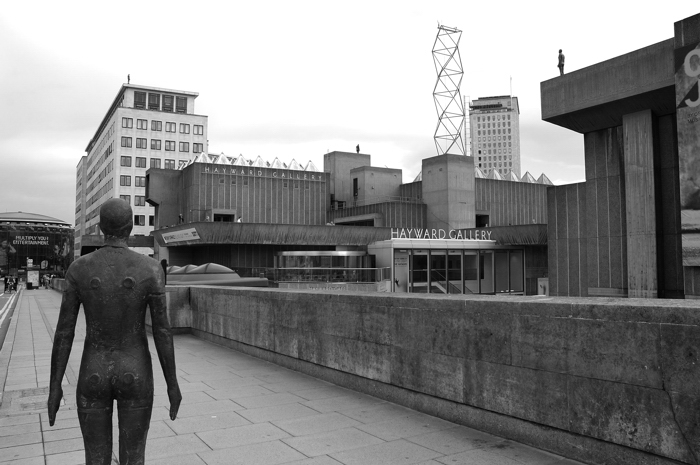
The artist in particular I've looked at in regards to audience is Antony Gormley.
His works, casts of his own body, shaved back to anonymity, seem to portray a feeling of venerability and disclusion. Unlike many cast human statues that we see, posing heroically or holding stoic postures, Gormley's body's stand hands by sides, crotch or shrink into fetal positions. The way in which i relate his work in relation to the audience that views it is through the way in which we are reminded of our own selves through the bodies. We are reminded of our own position in relation to space, our bodies being the only thing that we physically embody in life. Some work that emit this feeling of reminding us of our position is his recent work, 'Event Horizon'.
"From March 26 – August 15, 2010, 31 life-size figures appeared on rooftops, setbacks, and sidewalks around Manhattan’s historic Madison Square Park. Standing tall above the unique urban landscape of New York City, the figures were the work of celebrated British artist Antony Gormley as part of Event Horizon New York, Gormley’s long-awaited United States public art debut."
Perhaps it is through the act of looking and discovering these bodies that stand amongst the skyline the audience get an idea about their own scale in relation to the environment, such as the alienation that incorporates modern life.
Tuesday, October 19, 2010
Art and audience
Today i learn 't how to play an art game with an audience. it was like a test and involved memory. memory can be useful.there is a point when you get so over saturated with half formed ideas and information that it is hard to care about anything except the the immediate. a way in is sometimes through the use of fun to generate audience participation. the old fine line between active and passive participation is crucial to the way an art game is generated and how it will continue. the web is like a game which you can plug into anytime into any part (in theory) is possibly part of its popularity. but its not really even one on one- the audience just is not there in the old school sense and this must make a difference to the reactions you get .
ART & Its Audience
A great introduction to this area / introducing emerging conceptual ideas relating to pedagogy AS art:
Art and Audience
Been doing a little research on relational aesthetics.
From Bourriards writing (he coined the term):
http://www.creativityandcognition.com/blogs/legart/wp-content/uploads/2006/07/Borriaud.pdf
Some responses:
http://transform.eipcp.net/correspondence/1196340894#redir
Interesting stuff. I think alot of the art in Hartneys chapter is really well thought out on a conceptual level. But I like that it reaches out beyond an academic audience (unlike alot of the text based works that we have been looking at that formed part of the conceptual art movement)
From Bourriards writing (he coined the term):
http://www.creativityandcognition.com/blogs/legart/wp-content/uploads/2006/07/Borriaud.pdf
Some responses:
http://transform.eipcp.net/correspondence/1196340894#redir
Interesting stuff. I think alot of the art in Hartneys chapter is really well thought out on a conceptual level. But I like that it reaches out beyond an academic audience (unlike alot of the text based works that we have been looking at that formed part of the conceptual art movement)
Art & the Audience

Artist Vipoo Srivilasa is a ceramic sculptor who in the 2008 "Roop - Rote - Ruang" project directly engaged the audience. Roop - Rote - Ruang, or Taste - Touch - Tell, was an way to experience ceramics, wherein the guest actively participated by selecting their own plate, made a ceramic piece themselves and ate the that meal that the artist himself prepared. There were several interesting features of this performance/exhibition. It mirrored some buddhist methods, in that the food was passed clockwise, and incorporates the concept of 'ayatana' the term used to describe the six sense bases - sight, sound, smell, taste, touch, and the mind. The first course plates were chosen by the guest, which had a message of fortune inscribed on the underside of the plate. Next was the Best Wishes Soup, with a symbol of fortune uncovered at the bottom of the bowl as the soup was eaten. In the sharing of a meal the interrelationship between the work of art, the artist and the participants has been 'interrupted' in a traditional sense. It is a 2 way relationship, in that the audience is helping make Srivilasa's work and he is helping them make theirs. "The artist is interesting in creating opertunities for sharing between complete strangers and creating different, social ways of exploring complex ideas of his cross cultural experience."*
*http://www.vipoo.com/Content/Images/news/2008/roob_rote_ruang.pdf
http://www.artaustralia.com/article.asp?issue_id=189&article_id=207
Art and Spirituality


For Art and Spirituality I thought I would discuss the work of Alex Grey who explores in his art the mind the body and the soul. In his work he depicts "the human body that "x-ray" the multiple layers of reality, and reveal the interplay of anatomical and spirital forces"(quoted from Alex Grey Biography on alexgrey.com). His forms are reflective on his experiences in education (his anatomical education at Harvard Medical School) and his mind expanding experiences (the trips he took with his wife in college) and his interest in the psyche. What is prevalent in all his work from the begining of his practice to now is themes of death and transcendance. As an artist he is best known for the translucent glowing bodies which have been praised by renowned healers Olga Worral and Rosalyn Bruyere, his visionary figures are placed in human expieriences such as praying, sex, birth and meditation. He is well known for his Art work for Tool, which got me interested in his work, and he has also done work for Nirvana, SCI and Beastie Boys. I highly recommend going to his website, and also go on a tour of COSM (Chapel of Sacred Mirrors) the large piece/place that he in collaboration with his wife has created, he is very visionary in his ideas so don't get confused, its not an order, its really just a promotion of expressing ones creative path.
Alex Grey's Official Website- http://www.alexgrey.com/
Chapel of Sacred Mirrors Website- http://www.cosm.org/
http://www.arthistoryarchive.com/arthistory/visionary/- Also this website is notable to go to, its Artists discussion on Visionary Art, there is also Alex Grey's own discussion on the movement, very interesting.
Art and the Audience
Vuk Cosic in a net.art artist and prolific ASCII artist, which is using computer software to overlay videos with alphanumerical characters replacing colour pixels. net.art is simply art that is only broadcast over the internet, the web page is it’s context.
net.art came about in the early 90’s with the widespread adoption of internet connected desktop pc’s also the movement to graphically interfaced websites rather then text based sites that happened around 1993 pointed out by critic Rachel Greene.
Deep ASCII
Rather than showing the audience the work, in this case the film Deep Throat, Cosic is reaching deep into the recesses of code that is in the background of all digital transmissions and showing us the raw data. We know film is an illusion and we’re able to quite simply break it down to individual frames. But Video is different in that rather than being an illusion it’s a manipulation dots, and we aren’t able to break it down and understand it, a single still is made up of lines and lines of code indecipherable to all but the codec.
think this work comes out of the frustration of the net.art.ists failed dream that internet would become this all democratising bastion of knowledge and information. And it wasn’t, it was mostly used to look up porn and download pictures of cats. The choice of video then becomes obvious. We see all the work of programming code and encoding and decoding video, and all it’s used for is the smut transmission. The sad and ironic this is, is that a lot of the breakthrough in the way of file compression, video encoding and the like have come out of the supposed to need to broadcast porn over the world wide web.
Tv screen, night one
Tv screen, night one is a collection of video stills that Cosic captured while sitting in front of the television the night of the bombing of Yu during the NATO bombing of Kosovo. It shows at the time the authority of the television over the computer as a resource for gathering information. In some respects this still applies today, I’m more weary of information that has been easily posted online rather than information that has gone through a editing and publishing process.
Again Cosic has put up a layer with his medium between the content and the audience. They don’t see discernable information, they say frames, pixels. The background noise in the vast expanse of the internet.
A history of art for Airports is where Cosic comes out the digital ether and physically displays his works to the audience. However his very clever about the way he does this. Rather than displaying the work in the universal language of binary, he’s displaying it in the universal language of symbols, he is then placing the works in a complicated network like the internet in airports. By demeterialising the works he has turned into symbols, he is saying the history of art is beyond the object, beyond the output of a video screen, rather it’s in the raw code, it’s in the concept.
With all art being about concept as Cosic demonstrates, then the context of the work is imperative, meaning is lost when viewing A History of Art for Airports online, and vice versa with Deep ASCII and WAR (tv screen, night one)
Baumgärtel, Tilman, Net.art 2.0 : Neue Materialien zur Netzkunst, Nürnberg : Verlag für Moderne Kunst, 2001
Vuk Cosic http://www.ljudmila.org/~vuk/
Interview with Vuk Cosic http://we-make-money-not-art.com/archives/2006/02/interview-of-vu.php
net.art wikipedia entry http://en.wikipedia.org/wiki/Net.art
Subscribe to:
Posts (Atom)