Showing posts with label alex. Show all posts

Wednesday, October 20, 2010

Art and Audience


The artist in particular I've looked at in regards to audience is Antony Gormley.
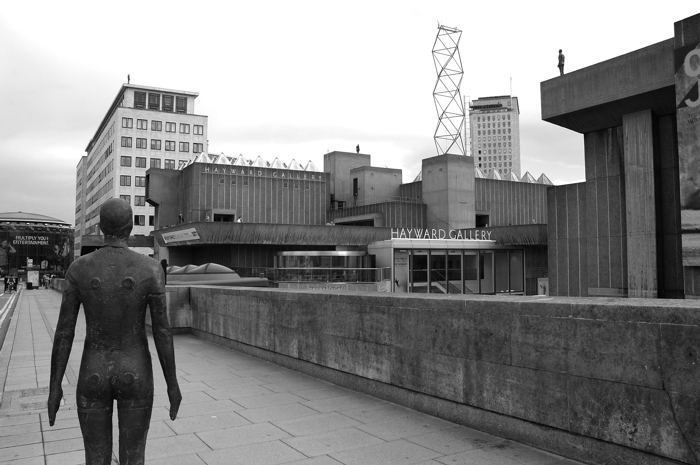
His works, casts of his own body, shaved back to anonymity, seem to portray a feeling of venerability and disclusion. Unlike many cast human statues that we see, posing heroically or holding stoic postures, Gormley's body's stand hands by sides, crotch or shrink into fetal positions. The way in which i relate his work in relation to the audience that views it is through the way in which we are reminded of our own selves through the bodies. We are reminded of our own position in relation to space, our bodies being the only thing that we physically embody in life. Some work that emit this feeling of reminding us of our position is his recent work, 'Event Horizon'. 


"From March 26 – August 15, 2010, 31 life-size figures appeared on rooftops, setbacks, and sidewalks around Manhattan’s historic Madison Square Park.  Standing tall above the unique urban landscape of New York City, the figures were the work of celebrated British artist Antony Gormley as part of Event Horizon New York, Gormley’s long-awaited United States public art debut."

Perhaps it is through the act of looking and discovering these bodies that stand amongst the skyline the audience get an idea about their own scale in relation to the environment, such as the alienation that incorporates modern life.


Monday, October 18, 2010

Wolfgang Laib: Returning to What Is

This interview with Laib gives us  an impression of his views on his practice as well as how his work is viewed. Laib seems very straight forward with his ideas on life and his goals, its almost as if the distinctions that separte work, llife and art are blurred from the way that Laib describes his practice. A simple, “that’s fine” seems to be justification for him feeling that his art is to be viewed in galleries as long as context of taking nature out of its environment is still valid. Most of the interview talks about his art practice, where he finds influence and what it means to be an artist. The most important piece of information I drew from the interview was the distinctions he drew between his practice and spiritualism. Even though his work is often misinterpreted he remains hopeful that his art I a by-product of his outlook on life. Laib also touches on the connections between himself and his work, drawing comparisons between his art and his life experience. His inspiration includes his past profession as a doctor, where he grew up and lives and his life experiences. Through working as a doctor he realised that he could only reach a certain “physical” level. However through his art practice he believes ht can touch people even deeper, possibly the entire world. His aim seems to be to give people the ability to see themselves in relation to the world in a different way.


His use of the word,  “Neutral space” when talking about a gallery, gives a unique spin on the idea of how a gallery or institution can function. He seems to be depoliticising the position a gallery takes in relation to art that is shown within it. The gallery may as well just function as four walls and a door as far as he is concerned.

 It seems this position he takes of what type of environment a gallery is informs the decisions he makes about his materials. This use of a foreign object in a neutral place allows a more “pure” form of work to be represented and abstracted. It is through this extraction of the raw material a deeper understanding of the material can be formed. From my reading of the work I find that he is trying to find definition of an object, how it exists. It is through this observation of a material outside of its frame we can discover more about what a material is and how we relate to it. 

 Throughout the interview we are brought back to the act of living itself being an artistic practice. Laib’s tedious day-to-day routine informed his artwork and in the end his work was evidence of that. The collection of the pollen alone was a performance and metaphor of life itself. The final act of dispersing the pollen within an empty space for others to view is an act of demonstration. It is through this demonstration Laib hopes to change the way in which we view life. 

Friday, October 15, 2010

Art and Institutions


Theo Jansen creates these Kinetically powered creatures he calls Strandbeests. As you can see these wind-powered plastic tube creatures, many the size of elephants and larger are amazing to watch.
 This Dutch bastard, artist, engineer creates these sculptures to roam the beaches of Holland and survive on their own via the wind. 
Im guessing he wants to create some form of new life, personally think he's insane.
Jansen is a pretty cool guy, he doesn't afraid of anything because he exhibits outside of an institutional format. 

If you like this i suggest watching his TED clip. Or is BMW sponsored clip.


http://www.youtube.com/watch?v=b694exl_oZo
(ted speech)

BMW clip

http://futurecraft.media.mit.edu/amitz/2007/09/24/theo-jansens-mechanism/
http://www.strandbeest.com/

Art and Politics

Dream City series (2007-08)


From my understanding Gao Xiaowu has never had a nine-to-five job—and he’s proud of it. However this good fortune reminds him of the millions who struggle among the mass of Chinese society. His Dream City sculptures (2007) present one view of such people: balloon-shaped men and women with tiny wings, who seem to be rooted and grounded to the earth, yearning to fly. The effect is both poignant and inspiring: these figures cannot fly. The artist writes: “I am looking for a world without reality … let’s go to a world without reality.” In the meantime, his work celebrates those who will never escape reality, yet never abandon hope. Gao Xiaowu’s pieces are a reflection of modern Chinese society, and portray innately Asian manerisisms and mental traits that combine to create a collective Asian identity.  Through his works I feel as though touch on the political climate of a pre-post communist China, if that makes any sense. His work remains very optimistic amongst the uncertainty of China’s politics. He speaks of the positive energy of the Chinese people as well as the pursuit of happiness occupying the mind of man or woman, regardless of age or social standing.


http://www.odetoart.com/artist.php/3861BDBE-1DE6-4AF0-B2D6-7524DDA3869A,Gao%20Xiao%20Wu

Monday, September 27, 2010

Arrt and gobilisation


I found out about Juile Watai aka Ai Amano aka Alice 100% moe (?) aka SAMURAI GIRL by looking for some reference material and found her Lolita (somewhat polite anime porn) style of photography pretty leet. In her early publication of 'Samurai Girl- spirituality and technology for the mor consciousness, Watai explores pop culture, which is largely influenced by the rising of otaku culture. Otaku, おたく, translates to someone elces house and has Been used in a negative context, referring to an obsessive compulsion (anime otaku = anime mania). However the Japanese gen y, whom have been hugely influenced by the west, have embraced this compulsion and have started a second pop revolution through the first globalization era.
After the war I believe Japans defeat took away whatever identity japan had, as though japan had lost an arm. It was only though this embrace of otaku culture japan's arm was patch worked together from pokemon blue and red cartridges, professional cosplay outfits, hardcore octopus hentai mangas, all of which influenced jap pop. Watai captures the contemporary aesthetic of the imaginary and virtual space through her portraits and performances. Through globalization the west has taken away Japanese innocence, inserted their own culture, only for it to be mutated into this contemporary introverted fluro kinky kawaii thing, that the west have embraced.

Monday, September 20, 2010

Art and spirituality


http://www.tate.org.uk/modern/exhibitions/eliasson/images/hallsun4.jpg

The way in which Olafur Eliasson might employ mechanics to create art contradictions that force viewers to question there own spirituality. Weather and environment, a once unexplainable force controlled by a omnipotent force, still symbolizes the surrealness of our existence.In The Weather Project, the fourth in the annual Unilever Series of commissions for the Turbine Hall, Olafur Eliasson takes this ubiquitous subject as the basis for exploring ideas about experience, spirituality and representation.

In this installation, The Weather Project, representations of the sun and sky dominate the expanse of the Turbine Hall. A fine mist permeates the space, as if creeping in from the environment outside. Throughout the day, the mist accumulates into faint, cloud-like formations before dissipating across the space. A glance overhead, to see where the mist might escape, reveals that the ceiling of the Turbine Hall has disappeared, replaced by a reflection of the space below. At the far end of the hall is a giant semi-circular form made up of hundreds of mono-frequency lamps. The arc repeated in the mirror overhead produces a sphere of dazzling radiance linking the real space with the reflection. Generally used in street lighting, mono-frequency lamps emit light at such a narrow frequency that colours other than yellow and black are invisible, thus transforming the visual field around the sun into a vast duotone landscape.

Through reenacting ritual and spirituals phenomenon, Eliasson suggests spirituality can be found within many different formats. The shared experience is a common feature that underpins his work, which is an important factor in art as it reminds us of our equality as humans. Yeh sure that's sounds nice and arty. What the hell am I writing about, as if anyones actually going to read this bullocks. Eliasson is a giant douche anyway, like only the Dutch would be like "ok ve need a giant sun in ze room , lots of lights for dees English faggots arhohoho" . The end.

http://www.tompenney.com.au/ESSAY%20ART%20SPIRIT%20TECH.doc
For more info.

Art and architecture


http://images.gizmag.com/gallery_lrg/4455_19080520119.jpg


Michael Rakowitz feels strongly about the issue of homelessness. So strongly that when he focussed his creative attentions on the subject he began manifesting practical outcomes, specifically the ParaSITE. The parasite is a is a small, collapsible, double-membrane shelter that uses the escaping warm air from a building’s HVAC system to inflate and warm the temporary home.

"While these shelters were being used, they functioned not only as a temporary place of retreat, but also as a station of dissent and empowerment; many of the homeless users regarded their shelters as a protest device, and would even shout slogans like "We beat you Uncle Sam!" The shelters communicated a refusal to surrender, and made more visible the unacceptable circumstances of homeless life within the city.

For the pedestrian, paraSITE functioned as an agitational device. The visibly parasitic relationship of these devices to the buildings, appropriating a readily available situation with readily available materials elicited immediate speculation as to the future of the city: would these things completely take over, given the enormous number of homeless in our society? Could we wake up one morning to find these encampments engulfing buildings like ivy?

This project does not present itself as a solution. It is not a proposal for affordable housing. Its point of departure is to present a symbolic strategy of survival for homeless existence within the city, amplifying the problematic relationship between those who have homes and those who do not have homes." Michael Rakowitz

I see this work as a reaction to the way we live. The reality is the modern form of architecture allows for mass homelessness to occur in cities. Societies fabric is hugely influenced by the way we live and people living on the strews is a byproduct of dense populations. Rakowitz tackles this idea head on by using the metaphor of the parasite, an organisms that uses it's host to survive, As a means to make a statement and create a temporary solution.

http://www.gizmag.com/go/4455/

Tuesday, August 10, 2010

Art and Identity: Nikki S. Lee, Annotated Bibliography


Skateboarders Project #7 (2000)


Yuppie Project #4 (1998)


Hispanic Project #18 (1998)

Nikki S. Lee is a Korean born New York City-based artist born in 1970. Her projects involve infiltrating various subcultures through mimicking the dress, gestures and mannerisms of the selected group. Her photographs work as the record of a hybrid process Lee has gone through. A process that is more performative then photography based.

Her process starts with the identification of a particular group in society, in which she becomes apart of over weeks or months. She tells the people within the group that she is an artist and what her intentions are, which in time has to great significance in her integration. At spontaneous times she asks whoever is around to take a photo, a happy snap. On each of the photos is the date stamp left by the cheap camera. This stamp emphasizes the amateur quality of the photographs, their lack of conventional composition. It feels like a mark of the ‘real’, the evidence of a precise moment when a group of people were together.

The photos seem genuine, even with the preparation Lee takes for each ‘role’, the photos don’t feel staged. She has used this process for a number of different projects, transforming herself into a skateboarding kid, an exotic dancer or a businesswoman. The success of the project relies on the acceptance by the group of Lee and capturing it on film.
Each viewer will find his or her equivalent – maybe not directly, but maybe through a scene or a mannerism to relate to.

We see Lee in the photos as if she has always been apart if that community or social group. Unlike an artist such as Cindy Sherman who also uses themes that relate to what identity is through replicating a cliché or stereotype within a studio. Lee practices only outside the studio, her work seems defined by the communities she is surrounded by. Lee states, “ I don’t think about nationality or race” and adds “I don’t need to up that issue because other people will”.

What ‘ive taken from her documented performance is that her work doesn’t distinguish between art and life. It doesn’t feel very ‘arty’ in the sense. Lee defines herself and what identity means though the relationships with other people. Her work isn’t about, ok now im going to be a goth, or a surfie. Lee addresses the question of identity though a holistic approach. Believing that the self exists only in relationship with community. It is my understanding that Lee isn’t even playing a role at all rather she tests her own identity. In turn understanding that if it is possible to be apart of any isolated group then a person’s identity is defined by its surroundings. That the individual cannot exist without the whole.


http://www.mocp.org/collections/permanent/lee_nikki_s.php
http://oneartworld.com/artists/N/Nikki+S.+Lee.html
en.wikipedia.org/wiki/Nikki_S._Lee

Art and Today. Heartney, Elanor, 2008, Phaidon.
Nikki s. Lee Projects. 2001, Cantz Hatje.
Nikki s. Lee Projects. 2001, Interview with Gilbert Vicario.

Sunday, August 8, 2010

Art and the Mind/Body: Stelarc

Stelarc (born Stelios Arcadiou on June 19, 1946 in Limassol, Cyprus to Greek Cypriot parents) is an Australian performance artist whose works focus heavily on futurism and extending the capabilities of the human body.
The one core theme that centers from Stelarc's works is the idea that the human body is obsolete. That without some sort of technological interference we will not advance. This idea of forced evolution to the body, to extends its limits is very apparent in his later work . As Stelarc states in an interview,"the body lacks of modular design," "Technology is what defines the meaning of being human, it's part of being human." Especially living in the information age, "the body is biologically inadequate."

Stelarc found a medical doctor willing to implant a cell-cultivated ear beneath the skin on the artist’s forearm. He apparently isn't satisfied with his newfound appendage just yet, however, and is reportedly planning another surgery to give the ear "more definition." What's more, he's also hoping to implant a microphone inside the ear that'll use a Bluetooth transmitter to, you guessed it, broadcast what it hears over the Internet.


Stelarc, (2007), 'Third Ear'.
http://eamazings.com/index.php/eamazings/stelarc-third-ear-implants-inside-his-arm.html


Although i do not agree with the idea of the body becoming second to that of technology as i can't see our technology becoming more advanced and complex then biology. I am fond of the integration between the body and the technology, as though the entities come from the same source. That stripping both down to raw particles dissolves any barriers that separate their origins.

There is also a fantastic interview with the artist in this link.
http://www.stanford.edu/dept/HPS/stelarc/a29-extended_body.html