


Watch this fantastic video for the details of his work:
http://www.mutualart.com/OpenArticle/Meet-the-TED-Prize-Winner-of--100-000--T/87F68DF44529C7F2?utm_source=newsletter_b&utm_medium=email&utm_campaign=nl_video
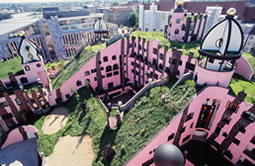

Waldspirale (Forest Spiral), Darmstadt, German (built 1990)
Hundertwasser is one of my favorite artists involved in architecture, for his strong philosophies and environment thoughts. For example, he believes it is better to walk on uneven floors and doesn't see why the windows on a building should be all aligned. A common feature of his work is that he despises the straight line, and so many of his building as asymmetrical. Some of his most famous buildings are Blumau, Kunsthaus Wien, Spittelau, 21st Century Clock and Mop Incinerator, Osaka. The most recent building have been built based on plans that Hundertwasser designed before his death in 2000. Grüne Zitadelle Von Madgeburg in German and The Ronald McDonald House in Essen, Germany are two examples of this. His philosophy embraces human existence in harmony with nature and aesthetics of life and art. He has written manifestoes in relation to architecture: Mouldiness Manifesto against rationalism in Architecture, Window Dictatorship and Window Rights, and There are No Evils of Nature - There are Only Evils of Man.
"Since his first artistic actions his thoughts circulate around the same topics: life, nature and all beauty, what happens between, next to function and profit. It attracts attention that the texts were cumulative subdivided, more targeted and gets more profoundness by and by. They obey not the trends, the rumour of the public and the exchange value, they owe their appearance the diligently and exact study of humans and their manifold interdependences and addictions, necessities and opportunities, but also their lapses… "
Walter Schurian, in: Friedensreich Hundertwasser, Schöne Wege, Gedanken über Kunst und Leben [Beautiful Paths, Thoughts on Art and Life] Writings 1943 - 1999, Munich 2004 (translation from German)
http://www.hundertwasser.de/english/texts/philosophie.php

Introduction Overview
Kandinsky firstly establishes that each art has its own time and place, and its authenticity cannot be restored in any manner. Such efforts to reproduce a work, style or method of art practice would only be artificial and imitation. He describes the thoughts, feelings and lifestyles in any particular time can never be replicated and as such, the art that is produced from this time can never be true as to have the same intent. Kandinsky places an importance on the inner feelings driving the art period, and goes on to make an exception to the above.
A revival of the external situations which fostered the inner feelings of the former time can be achieved through a similarity of ‘inner tendency in the whole moral and spiritual atmosphere,’ of the ideals and response, and as such, the reproductions of a former period and thus current. While seeming to be a contradiction, it somehow draws a parallel.
Kandinsky quotes Schumann and Tolstoi’s opposing views on the underlying purpose of the artist - as enlightener and inspirer or merely practicer. There, forms a great tension between the materialistic nature of the world today and the indifference of the heart and soul of a man. He denounces ‘art for art’s sake as a ‘squandering of artistic power,’ as aimless and materialistic. Kandinsky believes that the artist should look toward the higher ideals and engage in the inner feeling, as the spiritual life to which art belongs, transcends the fluctuations of the ‘moment’ and proves to influence and create a ‘deep and powerful prophetic strength.’
Kandinsky implies that the materialistic side of the art world produces the more inhumane natures of man, and divides society and indeed the art world, into those who appreciate only the external beauty and those who strive further for the inner thought. Both forms of art are consequently derived from the present as all art takes into account the feelings of its own time and place. But the art which creates further movement of thought and aims for spiritual inner thought and purpose stands constant.
 Jemima Wyman, Combat Drag, 2008 (production still), video, 8:06 mins.

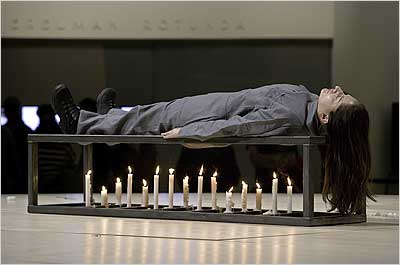
| Gina Pane The Conditioning, first of three phrases in Self-Portrait(s) Galerie Stadler, Paris January 11, 1973 Original duration: approximately 30 minute | Marina Abramovic's Performance of Gina Pane's The Conditioning, first of three phases in Self-Portrait(s) Solomon R. Guggenheim Museum, New York November 12, 2005 Duration: 7 hours |

Marina Abramovic, Breathing in/ Breathing out with Ulay, 1977, Photograph
Abramović’s art approaches the topic of art and the body as a personal investigation of physical limits and mental potentials. Her early influences include non-western cultures such a Tibetan Buddhism, Sufism, and traditional Australian Aboriginal customs searching for processes that push the body to the physical extremes in order to eliminate fear of death, pain and physical limitations. Also through these cultures she has learnt of a deeper form of energy present in the body, allowing herself to fast, endure pain or undertake intense hours of performance.
In using the medium of performance, she believes “the process has always been more important than the result, the performance more important than the object.” Since 1969 Abramović has created extensive performance artworks involving her body and the audience, encompassing the body and soul and the consciousness surrounding it. She finds direct connections of energy throughout the body, its surroundings, the earth and the cosmos. Abramović often starts a performance before the audience enters the space, and ends it after they are gone to control the presence and durability of the act. In some of her works, she engages the audience to complete the work, inviting them to participate, such as in the most recent collection of performances at MOMA entitled “The Artist is Present.” Here she sat in the gallery space at a table across from an empty chair, in which audience members were invited to sit for however long they desired. In one of her first performances, she called on the audience for manipulation of her body using 72 tools placed in front of her.
Abramović finds the process needed to create performances extremely important, as with the sense of live-ness that inherent during the performance. In contrast the documentation and medium used to capture the live performance produces an ‘expired’ copy, that can never imitate the live aspect and cannot be true to the art form. In her more recent works, Abramović focuses on the mental and physical conditioning of the artist and audience. Her work is a fascinating and enthralling example of an artist using the body as the subject, object and medium.
The three above works can be seen as a loose summary of style of artworks, the first being very focused on the simple sustainability of the body, the second as the endurance of the mind, and the third, the captivation of the audience. In Breathing in/ Breathing out with Ulay, the performers share the one breath until no longer possible - i.e they pass out. In this performance Ulay and Marina lasted 17 minutes. This piece really focuses on the physicality of the body and its limitations. In Abramovic's performance of Gina Pane's "The Conditioning" the core element is withstanding the pain mentally, much more so than a physical limitation. And finally, the most recent performance involved the artist engaging with the audience, sharing the energy and space between them.
This is also a great performance:
http://www.youtube.com/watch?v=pno1gCrbeVk
