I suspect there will only be two presenting tomorrow:
ALEX & BEN.
(Could you both let me know which artists you are presenting).
Amanda.
Monday, August 9, 2010

Art and The Body: Nandipha Mntambo
Artist Introduction:
Work:
Nandipha Mntambo was born in Swaziland (landlocked country in Southern Africa) in 1982. She graduated with a Masters degree in Fine Art with distinction from the Michaelis School of Fine Art, University of Cape Town, in 2007. Her first solo exhibition, Ingabisa, took place at Michael Stevenson in 2007. She recently showcased her work at MCA for Sydney Biennale, 2010.
Work:
She mostly uses cowhides in her sculptures and installations, which she moulds around her body, and she even moulded around her mother's body. Her work is known to be about feminity, gender roles and poetics of the body. The work shown below, fig.1 titled Iqaba Lami, makes reference to the 19th-century dress incorporating the Victorian bustle adopted by the Herero women of Namibia.


fig.1 Iqaba Lami fig.2 Indlovukati


fig.1 Iqaba Lami fig.2 Indlovukati
View:
Even though the work is done around human bodies, and talks about beauty and feminity, it reminded me more about social and political changes that took place in Africa, which reminds me that it could have been under Arts and The Politics as well. It is mainly due to the mention of Victorian bustle and Herero women of Namibia. I had previously done a little research on Himba tribe of Namibia, and I saw a strong resemblance to Herero women. Their garments are made up of cowhides, and how Herero women's silhouette transformed into that of Victorian women. Garments represented a certain era and how it was influenced by the ruler and people of that era. This reminded me of colonisation of Africa. Her works to me represented an amalgamation of Herero tribe and Victorian era's silhouette, which alone shows the adaptation of western civilisation, a diminish of tribes in Africa.
Reference:
Sunday, August 8, 2010
Art and the Mind/Body: Stelarc
Stelarc (born Stelios Arcadiou on June 19, 1946 in Limassol, Cyprus to Greek Cypriot parents) is an Australian performance artist whose works focus heavily on futurism and extending the capabilities of the human body.
The one core theme that centers from Stelarc's works is the idea that the human body is obsolete. That without some sort of technological interference we will not advance. This idea of forced evolution to the body, to extends its limits is very apparent in his later work . As Stelarc states in an interview,"the body lacks of modular design," "Technology is what defines the meaning of being human, it's part of being human." Especially living in the information age, "the body is biologically inadequate."
Stelarc found a medical doctor willing to implant a cell-cultivated ear beneath the skin on the artist’s forearm. He apparently isn't satisfied with his newfound appendage just yet, however, and is reportedly planning another surgery to give the ear "more definition." What's more, he's also hoping to implant a microphone inside the ear that'll use a Bluetooth transmitter to, you guessed it, broadcast what it hears over the Internet.

 Stelarc, (2007), 'Third Ear'.
http://eamazings.com/index.php/eamazings/stelarc-third-ear-implants-inside-his-arm.html
Although i do not agree with the idea of the body becoming second to that of technology as i can't see our technology becoming more advanced and complex then biology. I am fond of the integration between the body and the technology, as though the entities come from the same source. That stripping both down to raw particles dissolves any barriers that separate their origins.
There is also a fantastic interview with the artist in this link.
http://www.stanford.edu/dept/HPS/stelarc/a29-extended_body.html
Friday, August 6, 2010
Mind/Body + Art
Whats the difference between Art and Entertainment? Life is intertwined with both. The difference is hard to pick. A link may be the mediated thinking process not entirely separated from ego.
I am not my ego.
I can't help feeling that it is no coincidence that the type of body art we've been talking about talking about and its historical timing are pivotal to a Modernist way of thinking. There seems to be a self centered approach or is that part of the act?
I am not my ego.
I can't help feeling that it is no coincidence that the type of body art we've been talking about talking about and its historical timing are pivotal to a Modernist way of thinking. There seems to be a self centered approach or is that part of the act?
Art and the Body: Jessica Harrison
This UK artist has a series of furniture pieces which have the appearance of being sculpted from human skin. Her facination is with the ability of the human body to percieve experiences through the senses; touch, sight, taste, etc. She says that these both facilitate and interrupt our understanding of the world. She observes the human body as a tool with these functions, and explores our ability to have a sense of self within this body of complex processes.
Check the links for pics and info.
http://www.jessicaharrison.co.uk/page12.htm
http://www.edinburghsculpture.org/artist.aspx?artist=Jessica+Harrison
...As an interesting side story, at the The School of Anatomy and Human Biology at the University of Western Australia, a group of scientists have developed a tiny coat made of living tissue (skin). This coat was created as an "art form to illuminate our human conduct with other living systems.
"... by de-constructing our cultural meaning of clothes as a second skin through art, we raise questions about our exploitation of other living beings.”
It is a single piece, without seams, made from immortalised living cells.
It is known as Vitctimless Leather.
http://www.environmentalgraffiti.com/featured/clothes-that-grow-from-living-human-tissue/3162
Check the links for pics and info.
http://www.jessicaharrison.co.uk/page12.htm
http://www.edinburghsculpture.org/artist.aspx?artist=Jessica+Harrison
...As an interesting side story, at the The School of Anatomy and Human Biology at the University of Western Australia, a group of scientists have developed a tiny coat made of living tissue (skin). This coat was created as an "art form to illuminate our human conduct with other living systems.
"... by de-constructing our cultural meaning of clothes as a second skin through art, we raise questions about our exploitation of other living beings.”
It is a single piece, without seams, made from immortalised living cells.
It is known as Vitctimless Leather.
http://www.environmentalgraffiti.com/featured/clothes-that-grow-from-living-human-tissue/3162
Thursday, August 5, 2010
Art and The Body: Mike Parr

Art & The Body
I feel that this style of artform has two main ideas embedded within it, for both the artists and audience. That is to reconnect with oneself physiologically or physically, this could involve testing ones limits or simply heightening ones own senses or self awareness. Artists that incorporate the body within their practice are either performance artists whereby their practice can only be successfully experienced firsthand. Or else within the final works, there remains an essence of a body having been present.
One of my favourite artists, would have to be Mike Par (Sorry to repeat) but absolutely love him. Why am I so attracted to his practice? I would have to say, it is the same reason that I love gory films and perhaps also why I am so afraid of self harm.
There are three reasons, one allows me to mentally place Par into the box in the back of my brain as a fictional character. So I can aesthetically appreciate his practice without emotionally taking everything in. The second, would be the opposite when I emotionally allow myself to receive the full impact and confrontation of what Par is doing as if it were myself. And lastly, I simply think it's really cool that someone is gutsy enough to take the stupidest ideas such as 'nailing your arm to the wall' and actually doing it, and in the name of art.
_The_nail_midnight_.jpg)
_Mike_Parr_at_Midnight_.jpg)
Well - it’s obvious why I’m doing it. I’m doing it because I want to!
Mike Parr pushes both his physical and psychological limits to the extreme, his practice is highly confrontational and remains embedded in ones thoughts.
Wednesday, August 4, 2010
Art and the body-Mike parr

Parr's early works were designed to get a reaction from the audience one of Parr's earlier works, he sits in front of his audience and begins talking to them. Most of the people in the audience have no idea that he has one prosthetic arm. Suddenly he gets out an axe and begins hacking into his prosthetic arm which he has filled with minced meat and fake blood. quite shocking.
Art & The Body: Hananuma Masakichi


'Sculpture of self '(left), Hananuma Masakichi(right),
wood, hair, teeth, fingernails, toenails. 1885.
Masakichi discovered he was dying of tuberculosis and wanted to leave something behind for his wife. His last effort as a sculptor was to make a completely life like representation of himself out of wood. Each piece was caved separately and then joined together. Masakichi pulled out every single hair on his body to use on the sculpture. Each hair was placed into a tiny bored hole on the sculpture, corresponding to the exact place on his body. He did the same with his teeth, fingernails and toenails. He made the eyes of glass, they are completely anatomically correct. It was ten years before he actually died, so...maybe he should have waited a little longer to pull out his teeth.
Although this was completed 125 years ago, I feel that it has similarities with some contemporary practises. There is a definite element of the abject in this work, the use of actual bodily effects for one. The realism I want to relate to the work of Ron Mueck, Evan Penny, Jamie Salmon, Duane Hanson, Sam Jinks, as well as a work called 'Summit' 2010 by Shen Shoamin (political corpses in glass cases, which was on Cockatoo Island.)
Art & the BODY


Hey,
Heres an artist that I like who uses the body. Olaf Breuning is different from other artists we spoke about today for me. In almost all of his works the body or bodies are the main focus but they all have a similar nonsense that makes it seem like he is more interested in humans habits themselves... I dont know, what do you reckon?
(I published the eastern islands image because this is probably his most famous and if you want to look him up Phiadon has a monograph on him.)
he also has pretty much all of his work online
http://web.mac.com/olafbreuning/works/works.html
Art and the Body
 Karen Meninno
Karen Meninno was raised in London and born in India. Her works are from a range of mix media. She produces many types of sculptures representing her culture and identity. Through the materials she uses beads, Indian Sari she creates a variety of abstract forms. Her works are quite interesting as she produces abstract figurative forms portraying her own identity.
Each form represents multiple meanings of different issues she is inspired by.
Bound Sari Women, 2004

Arranged bride, 2004

The website link above portrays most of her sculptural works. She explains the methods, materials and the significance of her art practice.
Tuesday, August 3, 2010
Art and The Body

There seems to be a tendency when talking about the body within art to focus on gender and sexuality. I found Tania Bruguera's focus on the body as a product of social and political forces an interesting deviance from this general trend. Works like 'the burden of guilt' (1997) position the body in relation to a network of cultural histories and symbols.
http://www.taniabruguera.com/cms/210-0-Cuba+in+Tania+Brugueras+work+The+body+is+the+social+body.htm
The body
 I find it interesting that most people are looking at artist who depict the body in their sculpture. As the central axis through which we experience I wanted to look at an artist who force the viewer to become aware of their own body in space in relation to the work. Many of Richard Serra's works trough either scale or sense of weight or seemingly physical impossibility trigger a sensory disconnect or overwhelming sensation. Rather than mirroring the human form to speak of the body its function and our relationship to it, these often monolithic structures act in a binary with the viewer to distort the natural movement of the body through space or impinge upon it through sheer scale.
The Greatest Living Artist Of Our Time

Tom Leppard aka the Leopard Man covered his body in leopard like spots and fled society, living in a shack on the Isle of Skye.
He's clearly mad, but more advanced in thinking that the rest of us. We couldn't possibly understand the allegorical significance of his life, so I won't try.
He probably has syphilis, hence the madness. (not the band)
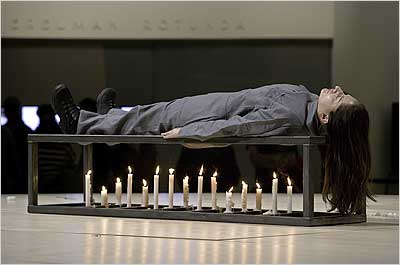
Art & the Body - Marina Abramović

Marina Abramović, The Artist is Present, Thursday June 3, 2010, MOMA - Marina Abramović with audience member
| Gina Pane The Conditioning, first of three phrases in Self-Portrait(s) Galerie Stadler, Paris January 11, 1973 Original duration: approximately 30 minute | Marina Abramovic's Performance of Gina Pane's The Conditioning, first of three phases in Self-Portrait(s) Solomon R. Guggenheim Museum, New York November 12, 2005 Duration: 7 hours |

Marina Abramovic, Breathing in/ Breathing out with Ulay, 1977, Photograph
Abramović’s art approaches the topic of art and the body as a personal investigation of physical limits and mental potentials. Her early influences include non-western cultures such a Tibetan Buddhism, Sufism, and traditional Australian Aboriginal customs searching for processes that push the body to the physical extremes in order to eliminate fear of death, pain and physical limitations. Also through these cultures she has learnt of a deeper form of energy present in the body, allowing herself to fast, endure pain or undertake intense hours of performance.
In using the medium of performance, she believes “the process has always been more important than the result, the performance more important than the object.” Since 1969 Abramović has created extensive performance artworks involving her body and the audience, encompassing the body and soul and the consciousness surrounding it. She finds direct connections of energy throughout the body, its surroundings, the earth and the cosmos. Abramović often starts a performance before the audience enters the space, and ends it after they are gone to control the presence and durability of the act. In some of her works, she engages the audience to complete the work, inviting them to participate, such as in the most recent collection of performances at MOMA entitled “The Artist is Present.” Here she sat in the gallery space at a table across from an empty chair, in which audience members were invited to sit for however long they desired. In one of her first performances, she called on the audience for manipulation of her body using 72 tools placed in front of her.
Abramović finds the process needed to create performances extremely important, as with the sense of live-ness that inherent during the performance. In contrast the documentation and medium used to capture the live performance produces an ‘expired’ copy, that can never imitate the live aspect and cannot be true to the art form. In her more recent works, Abramović focuses on the mental and physical conditioning of the artist and audience. Her work is a fascinating and enthralling example of an artist using the body as the subject, object and medium.
The three above works can be seen as a loose summary of style of artworks, the first being very focused on the simple sustainability of the body, the second as the endurance of the mind, and the third, the captivation of the audience. In Breathing in/ Breathing out with Ulay, the performers share the one breath until no longer possible - i.e they pass out. In this performance Ulay and Marina lasted 17 minutes. This piece really focuses on the physicality of the body and its limitations. In Abramovic's performance of Gina Pane's "The Conditioning" the core element is withstanding the pain mentally, much more so than a physical limitation. And finally, the most recent performance involved the artist engaging with the audience, sharing the energy and space between them.
This is also a great performance:
http://www.youtube.com/watch?v=pno1gCrbeVk
Art &The Body-David Altmejd

'Bizarre ... fascinating..hmmm
David Altmejd born in 1974, in Montreal in Canada. He is a sculptor/installtion artist. Altmejd's grandiosely-scaled sculptures and installtions are like the Hitchcock's celluloid narrative and the High Baroque poems embodies:they're monstrous, formless, excessive, bizarre, creepy impossible.
'figures made from an assortment of plaster, morphed mannequin parts, animal heads, crystals and birds are his primary subjects. He combines these things together to create a fantastical worls that plays with the conventions of reality'


Art & The Body: Ah Xian

China China Series
1997-1999
Porcelain body-cast, with hand painted
1997-1999
Porcelain body-cast, with hand painted
underglaze and overglaze decoration.

Head 1 (from 'China. China' series) 1997
Porcelain body-cast, with hand painted underglaze blue
Porcelain body-cast, with hand painted underglaze blue
and overglaze decoration in yellow, orange and green.
Ah Xian is an Australia based artist who immigrated from China in the 90's. His work mainly consists of porcelain busts which have been live-casted (the subject of the cast is living.) The style, design and quality of the porcelain is traditional to the Ming Dynasty and is still being produced today by skilled artisans. With help from some of these artisans, located in the region of Jingdezhen in China, Ah Xian was able to create these busts and many more like them.
All of the detail is hand painted in traditional styles, by the artist.
The process used picks up on the very fine details of the face and shows the beauty and delicacy of human features and the outside decoration accentuates that beauty. There is a feeling of serenity and calmness in this work, along with an almost morbid feeling. Regardless of how appealing these busts are there is still allusion to death masks and perhaps ancestor worship, as well. It is really difficult to believe that the subject inside was living at the time of the cast. While imagining the process, I can't help but to feel empathetically claustrophobic and on the verge of asphyxiation, albeit only a mild response.
art and the body
Renee Cox
is a one of African Americans most controversial artist of today.
she uses her body in her works to show and celebrate the "black" women and the woman's body also as a retaliation to society as it is/ was / still quite sexist and towards female artists and females and also racist towards her and other Renee Cox continues to push the envelop in her work, questioning society and the roles it gives to blacks and women with her elaborate scenarios and imaginative visuals that offend some and exhilarate others.
in the work below we see the last supper that she has adapted Leonardo's DA vinci last supper to her own interpretation where we see Renee Cox as Jesus which when first was shown caused great up roar. which Renee Cox is trying to show and portray
"I have a right to reinterpret the Last Supper as Leonardo DA Vinci created the Last Supper with people who look like hims.The hoopla and the fury are because I'm a black females. It's about me having nothing to hide."


is a one of African Americans most controversial artist of today.
she uses her body in her works to show and celebrate the "black" women and the woman's body also as a retaliation to society as it is/ was / still quite sexist and towards female artists and females and also racist towards her and other Renee Cox continues to push the envelop in her work, questioning society and the roles it gives to blacks and women with her elaborate scenarios and imaginative visuals that offend some and exhilarate others.
in the work below we see the last supper that she has adapted Leonardo's DA vinci last supper to her own interpretation where we see Renee Cox as Jesus which when first was shown caused great up roar. which Renee Cox is trying to show and portray
"I have a right to reinterpret the Last Supper as Leonardo DA Vinci created the Last Supper with people who look like hims.The hoopla and the fury are because I'm a black females. It's about me having nothing to hide."


Art and the body- John Coplans

 John Coplans
Body Parts
2003
John Coplans is an English artist living in the US who has at various stages of his career has been a painter, magazine editor, museum director and most recently a photographer. In his pictures his body is divided into sections which appear against a white background, usually with two of these images juxtaposed against each other. The arrangement of limbs in unusual positions causes the viewer to have to readjust their perspective on the body shown. Usually when the full figures shown it isn't necessary to look closely because your minds assumptions can fill in missing details, here the fragmented body parts look like unusual objects with different tones, textures, crevices and details so it's possible to view these body parts with a new perspective and see aspects of then that may have been overlooked otherwise. Coplans work is described as 'grotesque' which is true however the photographs don't have the confrontational and aggressive element featured in most of contemporary art regarding the body. His work has a gentle quality because of the black and white colour, relaxed poses and though flawed in many ways his skin seems beautiful in the way an elephants skin is, wrinkely but lived in.
This 'Body Parts' series was a reaction to the disaster of the World Traid Centre Towers. He lived in New york at the time and amid all the chaos this is what emerged from his photography. He says:" without consciously connecting the disaster to what I was photographing, I had started making images of my arms and legs and then collaging a pair of them together to make one image. After I had made four such images, I realised the connection when it was announced in the news that workmen were digging up debris andconstantly finding human body parts." This reminds me of what Michael said about the 'Raw and Cooked' project where your ideas come from somewhere even if you can't recognise where that is straight away.
Monday, August 2, 2010
Art and the Body - Janine Antoni
Janine Antoni is a contemporary artist who focuses predominantly on process, which is essential to the outcome of her work. She explores themes surrounding femininity, desire and pleasure, birth, death, motherhood and transformation. She works with an array of media, where sculpture, installation and performance all intertwine. Throughout her entire art practice, Antoni maintains a supreme connection with her body, in which she attempts to discover herself from the inside out. She undergoes repetitive and sometimes painful actions such as biting in order to fully become aware of her senses and to ‘get back inside the body’. In her works Lick and Lather, 1993, Touch, 2002 and Saddle, 2000, Antoni blurs the distinction between the artist and the artwork, using her body to physically transform the work.
For Lick and Lather Antoni made a series of busts of herself, using ephemeral materials of chocolate and soap. She then began eroding them by licking the chocolate and washing herself with the soap. This process provided the artist with a deeply physical connection to the work, in which she used her senses of taste, smell and touch to transform the busts. Antoni performs a loving and gentle ritual on the casts, leaving traces of herself and of the intimate experience that she has with the work. There is a strong female presence in this piece, which references the freedom of body and sexuality expressed in feminist performance art from the 1970’s.
 Lick & Lather, 1993
Two busts: one chocolate and one soap
24 x 16 x 13 inches
(60.96 x 40.64 x 33.02 cm)
Courtesy the Artist and Luhring Augustine, New York
 Touch 2002
Video still Courtesy of the artist and Luhring Augustine New York
 Saddle, 2000
Full Raw Hide; cast of artist's body
26 x 33 x 79 inches
Courtesy the Artist and Luhring Augustine, New York
Touch creates the illusion of walking on the horizon- something that is not physically possible but which resides in our imagination. With the help of a video camera, Antoni attempts to defy gravity by installing a wire that is level with the ocean line, and walking on it so that it appears that for a brief moment she is touching the horizon. While we know it is just an illusion, we get a sense of her body up in the air, with the wind and waves distorting her balance. The effect of this delicate image of Antoni against the horizon is to make us consider our own body balancing on a thin wire, which perhaps is a metaphor for the imbalance within our daily lives.
There is a coexisting presence and absence of the artist’s body in Saddle, which outlines the physical shape of her body underneath the hide of a cow. This work is about emptiness in form, as while we think that we can see her outline, Antoni really is not there. There is a spatial dislocation, which removes both the artist and the cow from their physical forms, leaving a ghostlike trace of two bodies that were once living and breathing. Finally, we notice that the artist’s body is in a defeated, crawling position, which ties in with the title of the piece. She is letting herself be dominated, such as the cow was in order to produce the hide, a defining element of the work. Saddle presents the body as a mortal, temporary state, which brings the viewer to question what happens to the body after death.
Antoni is at the same time removed and physically present in her practice, allowing viewers to draw on their own experience of the work. The artist engages with the theme of the body by using it to leave evocative traces within the work to which the viewer can relate. In doing so, she draws our awareness to our own body and senses.
Princenthal, Nancy, Janine Antoni: Mother's milk, (Art in America, New York: Sep 2001. Vol. 89, Iss. 9;124), 5
Heartley, Eleanor, Thinking Through the Body: Women Artists and the Catholic Imagination, (Hypatia,18.4 2003) 3-22
Heartley, Eleanor, Art and Today; Art and the Body, (New York, Phaidon Press, 2008), 217-239
Nixon, Mignon, Bad Enough Mother,October, Vol.71, Feminist Issues (The MIT Press: Winter, 1995), 70-92
http://www.luhringaugustine.com/artists/janine-antoni/#/images/1/
http://www.pbs.org/art21/artists/antoni/index.html
http://artnews.org/gallery.php?i=100
http://bombsite.com/issues/66/articles/2191
http://www.artcritical.com
For Lick and Lather Antoni made a series of busts of herself, using ephemeral materials of chocolate and soap. She then began eroding them by licking the chocolate and washing herself with the soap. This process provided the artist with a deeply physical connection to the work, in which she used her senses of taste, smell and touch to transform the busts. Antoni performs a loving and gentle ritual on the casts, leaving traces of herself and of the intimate experience that she has with the work. There is a strong female presence in this piece, which references the freedom of body and sexuality expressed in feminist performance art from the 1970’s.
 Lick & Lather, 1993
Two busts: one chocolate and one soap
24 x 16 x 13 inches
(60.96 x 40.64 x 33.02 cm)
Courtesy the Artist and Luhring Augustine, New York
 Touch 2002
Video still Courtesy of the artist and Luhring Augustine New York
 Saddle, 2000
Full Raw Hide; cast of artist's body
26 x 33 x 79 inches
Courtesy the Artist and Luhring Augustine, New York
Touch creates the illusion of walking on the horizon- something that is not physically possible but which resides in our imagination. With the help of a video camera, Antoni attempts to defy gravity by installing a wire that is level with the ocean line, and walking on it so that it appears that for a brief moment she is touching the horizon. While we know it is just an illusion, we get a sense of her body up in the air, with the wind and waves distorting her balance. The effect of this delicate image of Antoni against the horizon is to make us consider our own body balancing on a thin wire, which perhaps is a metaphor for the imbalance within our daily lives.
There is a coexisting presence and absence of the artist’s body in Saddle, which outlines the physical shape of her body underneath the hide of a cow. This work is about emptiness in form, as while we think that we can see her outline, Antoni really is not there. There is a spatial dislocation, which removes both the artist and the cow from their physical forms, leaving a ghostlike trace of two bodies that were once living and breathing. Finally, we notice that the artist’s body is in a defeated, crawling position, which ties in with the title of the piece. She is letting herself be dominated, such as the cow was in order to produce the hide, a defining element of the work. Saddle presents the body as a mortal, temporary state, which brings the viewer to question what happens to the body after death.
Antoni is at the same time removed and physically present in her practice, allowing viewers to draw on their own experience of the work. The artist engages with the theme of the body by using it to leave evocative traces within the work to which the viewer can relate. In doing so, she draws our awareness to our own body and senses.
Bibliography
Princenthal, Nancy, Janine Antoni: Mother's milk, (Art in America, New York: Sep 2001. Vol. 89, Iss. 9;124), 5
Heartley, Eleanor, Thinking Through the Body: Women Artists and the Catholic Imagination, (Hypatia,18.4 2003) 3-22
Heartley, Eleanor, Art and Today; Art and the Body, (New York, Phaidon Press, 2008), 217-239
Nixon, Mignon, Bad Enough Mother,October, Vol.71, Feminist Issues (The MIT Press: Winter, 1995), 70-92
http://www.luhringaugustine.com/artists/janine-antoni/#/images/1/
http://www.pbs.org/art21/artists/antoni/index.html
http://artnews.org/gallery.php?i=100
http://bombsite.com/issues/66/articles/2191
http://www.artcritical.com
Wednesday, July 28, 2010
WELCOME
Hi All,
The Course OUTLINE has been posted.
Please read the assessment guidelines in full and let me know if you have any questions.
PLEASE NOTE: Part 1 of the Presentation assessment has been simplified. You are required to provide an overall summary of research completed not an annotated bibliography for 3 separate references!
Amanda.
The Course OUTLINE has been posted.
Please read the assessment guidelines in full and let me know if you have any questions.
PLEASE NOTE: Part 1 of the Presentation assessment has been simplified. You are required to provide an overall summary of research completed not an annotated bibliography for 3 separate references!
Amanda.
Subscribe to:
Posts (Atom)