Arthur Ganson (b.1955 usa): amazing kinetic sculptor i came across listening to TED.com
he's works are quite musical and gestural as if they are trying to whisper something into your ears. listen to his talk on
http://www.ted.com/talks/arthur_ganson_makes_moving_sculpture.html
Sunday, October 24, 2010

art and audience
http://jumpinginartmuseums.blogspot.com/
blogspace JUMPINGINARTMUSEUMS created by Allison Reimus invites people to send in photos of themselves jumping in front of artworks and in art galleries. you should really check this blogspot up, its amazing. people from all around the world have posted their pictures, some hillariously funny some with amazing skills. in Allison Reimus's blogspot profile she writes
I am an avid Art Jumper. Sometimes, while visiting art museums and galleries, I am so excited by what I see that I have to jump for joy.
it is truly great to see people sharing such love for art. the audience role have not only heightened but these photographs have become new artworks themselves.

blogspace JUMPINGINARTMUSEUMS created by Allison Reimus invites people to send in photos of themselves jumping in front of artworks and in art galleries. you should really check this blogspot up, its amazing. people from all around the world have posted their pictures, some hillariously funny some with amazing skills. in Allison Reimus's blogspot profile she writes
I am an avid Art Jumper. Sometimes, while visiting art museums and galleries, I am so excited by what I see that I have to jump for joy.
it is truly great to see people sharing such love for art. the audience role have not only heightened but these photographs have become new artworks themselves.

Art & Political


Christian Boltanski
Art and Polictics, the topic already speaks about the individuals opions, or the world's events, it's interesting how every events or moments can relate to the topic. In fact, that a lot of artist create work based on their personal experience of their childhood, or past. The art and today book, talks about how creating artworks during different periods, was about engaging with the world, and social issues. The artist that I've chosen for this topic is Christian Boltanski.
Christian Boltanski is the one of my favourite artist, because the way he present the work, the art practice speaks about the story or emotions. Boltanski is known as the sculptor, painter, and installation artist. He create works that reflects on the events from the history, such as Halocaust. It's interesting how he is French artist, but because his father is Jewish he shares those memories from the history. I think his work is making the statment that each individuals are important to this world or the Earth, without considering one being poor or famous, its just being human.
Christian Boltanski's series of installation were named with the word 'archives' and 'monument', which the definition it self speaks about the memories and remembering the past. His art practice are based on collecting materials such as, newspaper script, photo, found objects, clothes and so on. When I was reading about his works, it said that the artist himself, doesn't have any detail of the people on the photographs. This idea of making artworks that artist doesn't have any connections with, are pretty, amazing, because their just from the past, whom past away somehow. But through his works, those individuals are remembered and again holds life within the installation.
Overall, I think his sculptural works, are so amazing and beautiful, it will be very thankful if someone in the future remembers me after I die. It's that scary but shows how important we are.
art and its institution - exhibition space
continuing on from the discussion we had in class for nick's presentation on art and audience i would like to discuss about "exhibition space" in relation to week 9's topic Art and its Institution. its interesting how one topic connects to everyting else. Personally i have to admit that i come across more artists and their works online than going to galleries and reading paper. this way i can keep up with new artists rising in iraq and south america with a tap of my finger. internet is what enables the world to communicate, thus globalise. it gives big and not so big yet artists opportunities to update their profiles and portfolios, and often use it as their new medium. there are now various online art galleries and auction sites, educational materials and network. it saves people time and effort. however whether this is all entirely healthy is questionable. i remember reading something on galleries and museums slowly losing their status in society. childrens are losing interest in physical activities and adults are too tired working six days a week. this is so unfortunate because seeing artworks in real life provides a very different experience from seeing it on your computer screen, most of the times. sculpture, performance and installation, especially. and whats the point of creating body of works if its only to be viewed online?
so what i really wanted to say was that we should all go gallery hopping sometime soon.
so what i really wanted to say was that we should all go gallery hopping sometime soon.
art and globalisation - biennale
hello everybody. Im sorry ive been really slack with blogging and its already our last week of 2010! I cant believe we got through this year this quick, its scary. Well im going to get on to some serious blogging so watch out.
First ive got some thoughts on biennale, the contemporary art festival, in relation to week 8's topic art and globalisation.
We've just had our 17TH SYDNEY BIENNALE. Apart from the overloaded MCA i quite enjoyed the works. Our biennale is the fourth oldest in the world since 1973 and probably the biggest international visual art event in sydney, maybe australia. According to the official biennale website, we have so far presented works of 1355 artists from 82 countries with 436,150 visitors attending 2008 sydney biennale. I wonder how much we had this year? To me, this is globalisation. It is an amazing experience to see how artists around the world interpret and create art. And through these works i can recognise the embedded cultural elements that are so similar yet different to one another. Biennale does more than just celebrate contemporary art, it promote international artists and raise awareness about the life around the globe, and upgrade our, the artists and the public's, understanding of art and the world.
globalisation dont only mean that the we, the artists, are influenced by the truth around the world but also that we have an opportunity to communicate back to the world population.
its great.
http://www.bos17.com/page/about_us.html
First ive got some thoughts on biennale, the contemporary art festival, in relation to week 8's topic art and globalisation.
We've just had our 17TH SYDNEY BIENNALE. Apart from the overloaded MCA i quite enjoyed the works. Our biennale is the fourth oldest in the world since 1973 and probably the biggest international visual art event in sydney, maybe australia. According to the official biennale website, we have so far presented works of 1355 artists from 82 countries with 436,150 visitors attending 2008 sydney biennale. I wonder how much we had this year? To me, this is globalisation. It is an amazing experience to see how artists around the world interpret and create art. And through these works i can recognise the embedded cultural elements that are so similar yet different to one another. Biennale does more than just celebrate contemporary art, it promote international artists and raise awareness about the life around the globe, and upgrade our, the artists and the public's, understanding of art and the world.
globalisation dont only mean that the we, the artists, are influenced by the truth around the world but also that we have an opportunity to communicate back to the world population.
its great.
http://www.bos17.com/page/about_us.html
Friday, October 22, 2010

Wednesday, October 20, 2010
The other blog?
Anyone know what the address for the blog that michael made for the processed bassed show was?
Art an spirituality Paul Laffoley

This guy is intense, he paints these huge detailed architectural esoteric diagrams
"his work is usually classified as visionary art or outsider art combine words and imagery to depict a spiritual architecture of explanation, tackling concepts like dimensionality, time travel through hacking relativity, connecting conceptual threads shared by philosophers through the millennia, and theories about the cosmic origins of mankind"
http://en.wikipedia.org/wiki/Paul_Laffoley
I suppose his work is considered outsider because it is!? I guess for me this is true outsider art... art that exists outside the art world. It speaks for itself really, hes kind of like a mad scientist coming up with all these crazy theories and linking them up with budhist mantras. when you look at them you can almost hear him rambling this stuff!
Art and Audience
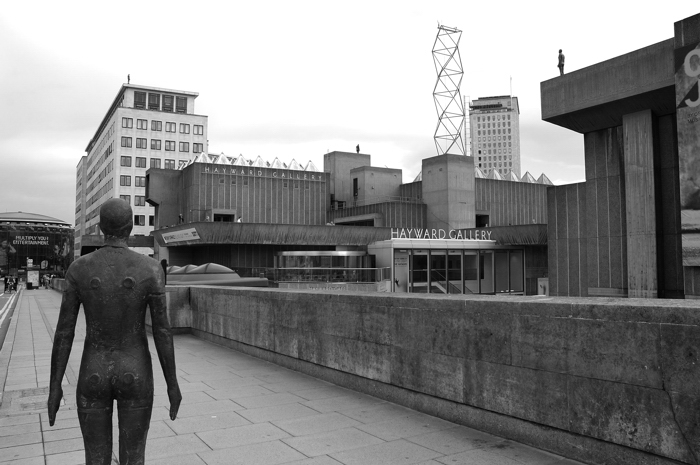
The artist in particular I've looked at in regards to audience is Antony Gormley.
His works, casts of his own body, shaved back to anonymity, seem to portray a feeling of venerability and disclusion. Unlike many cast human statues that we see, posing heroically or holding stoic postures, Gormley's body's stand hands by sides, crotch or shrink into fetal positions. The way in which i relate his work in relation to the audience that views it is through the way in which we are reminded of our own selves through the bodies. We are reminded of our own position in relation to space, our bodies being the only thing that we physically embody in life. Some work that emit this feeling of reminding us of our position is his recent work, 'Event Horizon'.
"From March 26 – August 15, 2010, 31 life-size figures appeared on rooftops, setbacks, and sidewalks around Manhattan’s historic Madison Square Park. Standing tall above the unique urban landscape of New York City, the figures were the work of celebrated British artist Antony Gormley as part of Event Horizon New York, Gormley’s long-awaited United States public art debut."
Perhaps it is through the act of looking and discovering these bodies that stand amongst the skyline the audience get an idea about their own scale in relation to the environment, such as the alienation that incorporates modern life.
Tuesday, October 19, 2010
Art and audience
Today i learn 't how to play an art game with an audience. it was like a test and involved memory. memory can be useful.there is a point when you get so over saturated with half formed ideas and information that it is hard to care about anything except the the immediate. a way in is sometimes through the use of fun to generate audience participation. the old fine line between active and passive participation is crucial to the way an art game is generated and how it will continue. the web is like a game which you can plug into anytime into any part (in theory) is possibly part of its popularity. but its not really even one on one- the audience just is not there in the old school sense and this must make a difference to the reactions you get .
ART & Its Audience
A great introduction to this area / introducing emerging conceptual ideas relating to pedagogy AS art:
Art and Audience
Been doing a little research on relational aesthetics.
From Bourriards writing (he coined the term):
http://www.creativityandcognition.com/blogs/legart/wp-content/uploads/2006/07/Borriaud.pdf
Some responses:
http://transform.eipcp.net/correspondence/1196340894#redir
Interesting stuff. I think alot of the art in Hartneys chapter is really well thought out on a conceptual level. But I like that it reaches out beyond an academic audience (unlike alot of the text based works that we have been looking at that formed part of the conceptual art movement)
From Bourriards writing (he coined the term):
http://www.creativityandcognition.com/blogs/legart/wp-content/uploads/2006/07/Borriaud.pdf
Some responses:
http://transform.eipcp.net/correspondence/1196340894#redir
Interesting stuff. I think alot of the art in Hartneys chapter is really well thought out on a conceptual level. But I like that it reaches out beyond an academic audience (unlike alot of the text based works that we have been looking at that formed part of the conceptual art movement)
Art & the Audience

Artist Vipoo Srivilasa is a ceramic sculptor who in the 2008 "Roop - Rote - Ruang" project directly engaged the audience. Roop - Rote - Ruang, or Taste - Touch - Tell, was an way to experience ceramics, wherein the guest actively participated by selecting their own plate, made a ceramic piece themselves and ate the that meal that the artist himself prepared. There were several interesting features of this performance/exhibition. It mirrored some buddhist methods, in that the food was passed clockwise, and incorporates the concept of 'ayatana' the term used to describe the six sense bases - sight, sound, smell, taste, touch, and the mind. The first course plates were chosen by the guest, which had a message of fortune inscribed on the underside of the plate. Next was the Best Wishes Soup, with a symbol of fortune uncovered at the bottom of the bowl as the soup was eaten. In the sharing of a meal the interrelationship between the work of art, the artist and the participants has been 'interrupted' in a traditional sense. It is a 2 way relationship, in that the audience is helping make Srivilasa's work and he is helping them make theirs. "The artist is interesting in creating opertunities for sharing between complete strangers and creating different, social ways of exploring complex ideas of his cross cultural experience."*
*http://www.vipoo.com/Content/Images/news/2008/roob_rote_ruang.pdf
http://www.artaustralia.com/article.asp?issue_id=189&article_id=207
Art and Spirituality


For Art and Spirituality I thought I would discuss the work of Alex Grey who explores in his art the mind the body and the soul. In his work he depicts "the human body that "x-ray" the multiple layers of reality, and reveal the interplay of anatomical and spirital forces"(quoted from Alex Grey Biography on alexgrey.com). His forms are reflective on his experiences in education (his anatomical education at Harvard Medical School) and his mind expanding experiences (the trips he took with his wife in college) and his interest in the psyche. What is prevalent in all his work from the begining of his practice to now is themes of death and transcendance. As an artist he is best known for the translucent glowing bodies which have been praised by renowned healers Olga Worral and Rosalyn Bruyere, his visionary figures are placed in human expieriences such as praying, sex, birth and meditation. He is well known for his Art work for Tool, which got me interested in his work, and he has also done work for Nirvana, SCI and Beastie Boys. I highly recommend going to his website, and also go on a tour of COSM (Chapel of Sacred Mirrors) the large piece/place that he in collaboration with his wife has created, he is very visionary in his ideas so don't get confused, its not an order, its really just a promotion of expressing ones creative path.
Alex Grey's Official Website- http://www.alexgrey.com/
Chapel of Sacred Mirrors Website- http://www.cosm.org/
http://www.arthistoryarchive.com/arthistory/visionary/- Also this website is notable to go to, its Artists discussion on Visionary Art, there is also Alex Grey's own discussion on the movement, very interesting.
Art and the Audience
Vuk Cosic in a net.art artist and prolific ASCII artist, which is using computer software to overlay videos with alphanumerical characters replacing colour pixels. net.art is simply art that is only broadcast over the internet, the web page is it’s context.
net.art came about in the early 90’s with the widespread adoption of internet connected desktop pc’s also the movement to graphically interfaced websites rather then text based sites that happened around 1993 pointed out by critic Rachel Greene.
Deep ASCII
Rather than showing the audience the work, in this case the film Deep Throat, Cosic is reaching deep into the recesses of code that is in the background of all digital transmissions and showing us the raw data. We know film is an illusion and we’re able to quite simply break it down to individual frames. But Video is different in that rather than being an illusion it’s a manipulation dots, and we aren’t able to break it down and understand it, a single still is made up of lines and lines of code indecipherable to all but the codec.
think this work comes out of the frustration of the net.art.ists failed dream that internet would become this all democratising bastion of knowledge and information. And it wasn’t, it was mostly used to look up porn and download pictures of cats. The choice of video then becomes obvious. We see all the work of programming code and encoding and decoding video, and all it’s used for is the smut transmission. The sad and ironic this is, is that a lot of the breakthrough in the way of file compression, video encoding and the like have come out of the supposed to need to broadcast porn over the world wide web.
Tv screen, night one
Tv screen, night one is a collection of video stills that Cosic captured while sitting in front of the television the night of the bombing of Yu during the NATO bombing of Kosovo. It shows at the time the authority of the television over the computer as a resource for gathering information. In some respects this still applies today, I’m more weary of information that has been easily posted online rather than information that has gone through a editing and publishing process.
Again Cosic has put up a layer with his medium between the content and the audience. They don’t see discernable information, they say frames, pixels. The background noise in the vast expanse of the internet.
A history of art for Airports is where Cosic comes out the digital ether and physically displays his works to the audience. However his very clever about the way he does this. Rather than displaying the work in the universal language of binary, he’s displaying it in the universal language of symbols, he is then placing the works in a complicated network like the internet in airports. By demeterialising the works he has turned into symbols, he is saying the history of art is beyond the object, beyond the output of a video screen, rather it’s in the raw code, it’s in the concept.
With all art being about concept as Cosic demonstrates, then the context of the work is imperative, meaning is lost when viewing A History of Art for Airports online, and vice versa with Deep ASCII and WAR (tv screen, night one)
Baumgärtel, Tilman, Net.art 2.0 : Neue Materialien zur Netzkunst, Nürnberg : Verlag für Moderne Kunst, 2001
Vuk Cosic http://www.ljudmila.org/~vuk/
Interview with Vuk Cosic http://we-make-money-not-art.com/archives/2006/02/interview-of-vu.php
net.art wikipedia entry http://en.wikipedia.org/wiki/Net.art
Art and Audience


T-shirt worn by lady pink, New York, 1983
Jenny Holzer
When I choose art and audience as the topic I thought it was such an interesting topic to talk about. For many generations the perception of art has been an outrageous debate on how one acknowledges an artwork. Depending on how and where the artist exhibits the work relies on how the work is viewed by the audience. For example having an artwork of various forms exhibited in a gallery one is engaging with the work as a personal interest to art. On the other hand having an artwork displayed in public areas, landscape architecture forces the audience to engage to look at the work.
Jenny Holzer is an American conceptual artist. She was born in 1950 Gallipolis Ohio. She moved to New York in the 1970 and began working creating text based artworks.
In various places around the world she displays texts using LED on landscapes, building; streets, rivers and oceans throughout Europe and America. Her work is publicly shown, the audience forcefully engages with her texts whether or not one is interested in art. Located in public spaces the spectator is being forced to acknowledge the sentences allowing them to engaged and have a personal response.
"I started the work as a parody, like the Great Ideas of the Western World in a nutshell," to make "big issues in culture intelligible as public art." She challenges the public to take position deciding whether they agree or not with what is being stated. She portrays a strong tone with the text that’s forces the reader to stop and enage.

During the 1970s she began her series truisms. The above two photo images are text from this series. The text "The abuse of powere comes as no suprise" was displayed in various areas and forms. Topic areas that she usually writes about in this period and displays are themes of war, money, violence, sex. The experiences, issues activities in life that continuously moves on and how it affects society over time. She wants the audience to take part of the text as a reminder of issues in society. She completed a few series in her art practice and all contain text aiming to the public and how the audiences enages within her work. She has completed a few series in her art practice some are Truisms, Lustmord, Inflammtory essays. Each series focuses on various issues which is significant to Holzer.
The link below are some of the quotes stated by her throughout the Truisms period.
Read my lips, Jenny Holzer, Barbara Kruger, Cindy Sherman. National art Gallery of Australia, Canberra ACT 2600, 1998, Edited by Pauline Green.
Jenny Holzer, Phaidon Press Limited, London, 1998.
http://www.o-matic.com/public_art/holzer.html (The above stated quote).
Art & Audience - Brook Andrew
'Art and audience’ can discuss a number of different movements or techniques in art, and the great variety of ways the audience can react to or change an artwork. Interactive artworks, however, seem the easier way to involve the audience, so that they become an vital part of the work itself.
One work that I had intended to see, (and am now very disappointed that I missed it) was The Cell, by Brook Andrew. I am seriously annoyed that I missed that. Just look at the links. It would have been so good. This work is essentially a jumping castle. It combines art, a jumping castle and exploration. You can never top that.
Apparently the work deals with ideas of cultural identity and consumerism. I don’t need to know that to catch my interest. I just need to know it’s an inflatable rectangle you are allowed the climb in. Although this doesn’t help convey my knowledge of art, I think it appeals to a study of human nature and engaging the audience. Would you say no to climbing into the cell?
For people who do not usually take an interest in art, there may be a number of reactions. Would it attract their attention and cause them to consider the artist’s intention? Would they consider it just another one of those weird things the crazy artists do? Would it not matter what the work meant, it would just become an experience to enjoy?
This choice of material is in opposition to the title of the work. Being a cell, a container for people, who for whatever reason must be kept away from other people, this work should discourage participants from entering. However people are attracted to exploring new spaces, jumping castles and bright colours. This may show that curiosity and a desire for new experiences can overpower misgivings. This may show that the power placed on certain phrases or words, and our associations that guide our choices are illogical. This may just be an experience where the audience can become the author in a space cut off from reality.
Some links have information. Some have pictures. Enjoy.
http://www.nelsonmeersfoundation.org.au/case-studies/SHERMAN-CONTEMPORARY-ART-FOUNDATION-BROOK-ANDREWS-THE-CELL
http://www.sydneydesign.com.au/2010/index.php/exhibitions/brook-andrew-the-cell
http://manexus.ning.com/events/brook-andrew-the-cell
http://www.abc.net.au/rn/artworks/galleries/2010/2948335/image2.htm
One work that I had intended to see, (and am now very disappointed that I missed it) was The Cell, by Brook Andrew. I am seriously annoyed that I missed that. Just look at the links. It would have been so good. This work is essentially a jumping castle. It combines art, a jumping castle and exploration. You can never top that.
Apparently the work deals with ideas of cultural identity and consumerism. I don’t need to know that to catch my interest. I just need to know it’s an inflatable rectangle you are allowed the climb in. Although this doesn’t help convey my knowledge of art, I think it appeals to a study of human nature and engaging the audience. Would you say no to climbing into the cell?
For people who do not usually take an interest in art, there may be a number of reactions. Would it attract their attention and cause them to consider the artist’s intention? Would they consider it just another one of those weird things the crazy artists do? Would it not matter what the work meant, it would just become an experience to enjoy?
This choice of material is in opposition to the title of the work. Being a cell, a container for people, who for whatever reason must be kept away from other people, this work should discourage participants from entering. However people are attracted to exploring new spaces, jumping castles and bright colours. This may show that curiosity and a desire for new experiences can overpower misgivings. This may show that the power placed on certain phrases or words, and our associations that guide our choices are illogical. This may just be an experience where the audience can become the author in a space cut off from reality.
Some links have information. Some have pictures. Enjoy.
http://www.nelsonmeersfoundation.org.au/case-studies/SHERMAN-CONTEMPORARY-ART-FOUNDATION-BROOK-ANDREWS-THE-CELL
http://www.sydneydesign.com.au/2010/index.php/exhibitions/brook-andrew-the-cell
http://manexus.ning.com/events/brook-andrew-the-cell
http://www.abc.net.au/rn/artworks/galleries/2010/2948335/image2.htm
Monday, October 18, 2010
Wolfgang Laib: Returning to What Is
This interview with Laib gives us an impression of his views on his practice as well as how his work is viewed. Laib seems very straight forward with his ideas on life and his goals, its almost as if the distinctions that separte work, llife and art are blurred from the way that Laib describes his practice. A simple, “that’s fine” seems to be justification for him feeling that his art is to be viewed in galleries as long as context of taking nature out of its environment is still valid. Most of the interview talks about his art practice, where he finds influence and what it means to be an artist. The most important piece of information I drew from the interview was the distinctions he drew between his practice and spiritualism. Even though his work is often misinterpreted he remains hopeful that his art I a by-product of his outlook on life. Laib also touches on the connections between himself and his work, drawing comparisons between his art and his life experience. His inspiration includes his past profession as a doctor, where he grew up and lives and his life experiences. Through working as a doctor he realised that he could only reach a certain “physical” level. However through his art practice he believes ht can touch people even deeper, possibly the entire world. His aim seems to be to give people the ability to see themselves in relation to the world in a different way.
His use of the word, “Neutral space” when talking about a gallery, gives a unique spin on the idea of how a gallery or institution can function. He seems to be depoliticising the position a gallery takes in relation to art that is shown within it. The gallery may as well just function as four walls and a door as far as he is concerned.
It seems this position he takes of what type of environment a gallery is informs the decisions he makes about his materials. This use of a foreign object in a neutral place allows a more “pure” form of work to be represented and abstracted. It is through this extraction of the raw material a deeper understanding of the material can be formed. From my reading of the work I find that he is trying to find definition of an object, how it exists. It is through this observation of a material outside of its frame we can discover more about what a material is and how we relate to it.
Throughout the interview we are brought back to the act of living itself being an artistic practice. Laib’s tedious day-to-day routine informed his artwork and in the end his work was evidence of that. The collection of the pollen alone was a performance and metaphor of life itself. The final act of dispersing the pollen within an empty space for others to view is an act of demonstration. It is through this demonstration Laib hopes to change the way in which we view life.
Art and Audience
I thought I would use this week's topic as an opportunity to talk about a piece that I am working on for Studio Extension. It's a shame that I don't get to see what you are all working on and vice versa, so here is a brief description of what I am trying to convey through this work. (If you haven't spotted it yet, it's the one made of clear packing tape and feathers stuck on the big white wall opposite the 2nd year studios... oh and it's not quite finished yet!)
The work is directly about the here and now, exploring transcendental concepts surrounding form, space and the void. In doing so, it abstracts architectural structures in which we function and move through within our daily lives. It incorporates the architectural surface so that the forms seemingly grow and protrude out from within the wall. The wall becomes more than just a flat two-dimensional and unexceptional structure, as the voids within the forms indicate an interior. While this illusion encourages greater awareness of the space and of our interaction with the space, the voids are impenetrable. They are filled with matter and sealed off from the viewer. This leads us to consider the space in a new light, looking into its unreal yet organic appearance.
The connection between the work and its audience is that when the onlooker views the form they become the beholder of that space, and thus more aware of their relationship with it. I think it is important to look at the notion of art and audience in a metaphysical manner, whereby a work which falls under the theme of abstract, or spiritual, or transcendental, or something along those lines, encourages the viewer to look within and reflect on their own state of existence.
The work is directly about the here and now, exploring transcendental concepts surrounding form, space and the void. In doing so, it abstracts architectural structures in which we function and move through within our daily lives. It incorporates the architectural surface so that the forms seemingly grow and protrude out from within the wall. The wall becomes more than just a flat two-dimensional and unexceptional structure, as the voids within the forms indicate an interior. While this illusion encourages greater awareness of the space and of our interaction with the space, the voids are impenetrable. They are filled with matter and sealed off from the viewer. This leads us to consider the space in a new light, looking into its unreal yet organic appearance.
The connection between the work and its audience is that when the onlooker views the form they become the beholder of that space, and thus more aware of their relationship with it. I think it is important to look at the notion of art and audience in a metaphysical manner, whereby a work which falls under the theme of abstract, or spiritual, or transcendental, or something along those lines, encourages the viewer to look within and reflect on their own state of existence.
Sunday, October 17, 2010
Art & Audience: rAndom International and Chris O'Shea
The installation is a collaboration work of rAndom International and Chris O'Shea. The concept, design and hardware are by rAndom International, and the software, which was developed in C++ using openFrameworks and OpenCV is by Chris O'Shea.
"When members of the audience occupy the space, the mirrors inquisitively follow someone that they find interesting. Having chosen their subject, they all synchronise and turn their heads towards them. Suddenly that person can see their reflection in all of the mirrors. They will watch this person until they become disinterested, then either seek out another subject or return to their private chatter. The collective behaviour of the objects is beyond the control of the viewer, as it is left entirely to their discretion to let go of their subject.
The installation aims to reverse the roles of the viewer and the viewed during this in-voluntary interaction. It seeks to establish a different kind of relationship between viewer and technology. Will other members of the audience experience the sensation of being ignored or excluded when they are not the centre of attention? Will the installation create a feeling of un-ease and unsettlement? The work investigates if machines can evoke diverse emotional reactions with the simplest of means."


 Audience, Random International, 2008
It is like a painting or sculpture automatically flipping and turning its back on me, just because it doesn't like me, or I am not interesting enough as an audience. That's what this installation is doing or inteded to do - choosing its audience, rather than audience having the liberty to engage with the artwork of their choice. It has a modern appeal, both in terms of visual aesthetic and properties. Apart from being interactive and engaging for both adults and children, it traces me back to my experiences with technology. It is about losing control and power over your own creation that you once naively thought would move in your rhythm. It makes me think of having to wait for a page to upload, and losing my patience if it takes more than few seconds, and losing a document that is yet to be saved. It doesn't understand our emotions, yet we have succumbed to it; we adjust ourselves to the way system functions, the system that was once created by one of us.
"When members of the audience occupy the space, the mirrors inquisitively follow someone that they find interesting. Having chosen their subject, they all synchronise and turn their heads towards them. Suddenly that person can see their reflection in all of the mirrors. They will watch this person until they become disinterested, then either seek out another subject or return to their private chatter. The collective behaviour of the objects is beyond the control of the viewer, as it is left entirely to their discretion to let go of their subject.
The installation aims to reverse the roles of the viewer and the viewed during this in-voluntary interaction. It seeks to establish a different kind of relationship between viewer and technology. Will other members of the audience experience the sensation of being ignored or excluded when they are not the centre of attention? Will the installation create a feeling of un-ease and unsettlement? The work investigates if machines can evoke diverse emotional reactions with the simplest of means."


 Audience, Random International, 2008
It is like a painting or sculpture automatically flipping and turning its back on me, just because it doesn't like me, or I am not interesting enough as an audience. That's what this installation is doing or inteded to do - choosing its audience, rather than audience having the liberty to engage with the artwork of their choice. It has a modern appeal, both in terms of visual aesthetic and properties. Apart from being interactive and engaging for both adults and children, it traces me back to my experiences with technology. It is about losing control and power over your own creation that you once naively thought would move in your rhythm. It makes me think of having to wait for a page to upload, and losing my patience if it takes more than few seconds, and losing a document that is yet to be saved. It doesn't understand our emotions, yet we have succumbed to it; we adjust ourselves to the way system functions, the system that was once created by one of us.
Bibliography:
http://www.chrisoshea.org/audience Art and Politics

Gunter Demnig
Stolperstein (Stumbling Blocks)
He creates blocks displayed on sidewalks around the cities, vilages and towns in Germany. He engraves words beginning with "Here lived" one on block. He illustrates the identities of people killed by the Nazi's in reference to their name, date and place of death. He has always been interested in pulic interests cultures and issues as a political artist.
He displays the stones himself bringing back the names of the holocaust victims for the public and audience to view. His style of making blocks is quite interesting and is a exceptional way of remembering the dead. As one walks by these blocks reads the word which is imprinted on the blocks and attracts the viewer attention.
Subscribe to:
Posts (Atom)