I had a lot of difficulty with this topic I didn’t want to reference obvious artists (Olafur Eliasson and Laib Wolfgang,) but couldn’t find/think of any other artist’s that fitted within the topic. I think I had so much difficulty with this topic because I couldn’t push past the connection to religion that spirituality has. When I researched the definition of spirituality it provided me with some sense of clarity, an understanding as to why I couldn’t find an artist that represents spirituality. The reason being that, spirituality is in fact unattainable we can experience it but we cannot contain it, thus It is impossible for artists to truly represent spirituality. My difficulty may also lie within my inability to see something that is spiritual from another persons percpective, as i feel that spirituality is an individual's experience. So instead of finding artwork's i googled some natural phenomena's which i think are pretty amazing.
Various definitions: -Spirituality is the level to which one is able to see past there own self.
- The ability to tap into areas of life beyond what is normal (what is able to be easily seen, heard, felt, and smelt)
-Spirituality is often experienced as a source of inspiration or orientation in life. It can encompass belief in immaterial realities or experiences of the immanent or transcendent nature of the world
I feel that this topic ‘Art & Audience’ is the most obvious and off the most importance, as art’s purpose is to be seen. Whether the audience is simply the artist who creates the work; the general public; or other artists. The artists Intention is to provide audiences with a different perception in relation to various situations and life in general.
Artist Derrick Haung held a residency at SCA this year for two week’s he’s really lovely and showed me some of the works he had previously created and exhibited. Derrick’s works are primarily interactive installations and sometimes include a performative aspect, fitting perfectly within the topic ‘art & audience’. His work frequently incorporates a sensory aspect, through the use of dried popori; fruit; and leaves which the audience is unable to ignore. Derrick uses both visual and sensory aspects within his work that enable the audience to fully interact and become immersed.“Another kind of aromas” exists as a darkened room containing a low rectangular container, filled with dried organic material free to touch, and a variety of hand packaged spices hanging neatly and freely on the walls. The packages and the material within the open box are beautifully illuminated by light. “Hidden Place” is within a small exhibition space, filed with dried leaves and warm lighting, central to the space is a cylindrical-like structure reminiscent of netting used to keep away insects, and pieces of loose thread which hang freely around the structure like cobwebs or roots. The structure is large enough for a person to stand; sit; or lie within it. The warm lighting and dried leaves evoke the sense of being within nature, and the netting seems to take me a step back in time, triggering memories of building cubby houses with pegs and sheets as a child, pretending I was elsewhere. “Consumption” was a performative work in which Derrick sat within a space filled with red cotton waste, peeling the rinds off oranges in which he then latter re-sowed together. How I interpritate this work in relationship to it’s title and the repetitive action in which Derrick performs, is essentially a statement concerning the overwhelming consumption of food. The loose orange peels represent the waste of produce and the sewing-together is then perhaps is a direction to recycle and reuse.
"Another kind of aromas" spices, box, documents, 2007
I think Derrick’s work is beautiful and I’m a little bit jealous, I absolutely love the use oforganic and deteriorating material, evoking the sensors, and mentally and physically recreating a space elsewhere. I hope you all got to meet him.
Im not sure if anyone has already heard of this artist, he was the winner of the TED art prize. In regards of globalisation, JR is interested in the individual and each person's fate, and takes up themes of photographing groups of people and pasting their images on gigantic landscapes, such as the slums in Kenya, corresponding with trains and landscape features. The images are black and white, and relate to social issues such as Portrait of a generation, 2006, portraits of the suburban gangsters which were enlarged and covered buildings in the middle class areas of his home city Paris. Since this project, he has travelled throughout Europe and the world, creating similar works, projecting regional social and racial issues out into the mainstream world. the two most recent undertakings have been particularly ambitious - Face 2 Face, 2007, saw huge portraits of Palestinians and Israelis positioned on either side of the Separation Wall in eight cities of each country. In 2008, Women presented the issues confronting women in countries where they are subject to discrimination and hostility. These site specific installations create questions of freedom, identity and cultural differences to those who care to investigate. For others, they are simply a humungous funny face that brings laugher and connects people in the community. Other interesting points of his work are that he remains anonymous and is he calls himself a graffiti artist, as his work is displayed illegally on the streets and buildings of the locality. This also raises questions of who does this art belong to - JR? the global community? I think these are the questions he is trying to raise.
Watch this fantastic video for the details of his work:
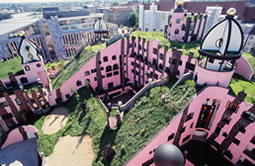
The Green Citadel of Magdeburg, Germany (2002 - 2005)
Waldspirale (Forest Spiral), Darmstadt, German (built 1990)
Hundertwasser is one of my favorite artists involved in architecture, for his strong philosophies and environment thoughts. For example, he believes it is better to walk on uneven floors and doesn't see why the windows on a building should be all aligned. A common feature of his work is that he despises the straight line, and so many of his building as asymmetrical. Some of his most famous buildings are Blumau, Kunsthaus Wien, Spittelau, 21st Century Clock and Mop Incinerator, Osaka. The most recent building have been built based on plans that Hundertwasser designed before his death in 2000. Grüne Zitadelle Von Madgeburg in German and The Ronald McDonald House in Essen, Germany are two examples of this. His philosophy embraces human existence in harmony with nature and aesthetics of life and art. He has written manifestoes in relation to architecture: Mouldiness Manifesto against rationalism in Architecture, Window Dictatorship and Window Rights, and There are No Evils of Nature - There are Only Evils of Man.
"Since his first artistic actions his thoughts circulate around the same topics: life, nature and all beauty, what happens between, next to function and profit. It attracts attention that the texts were cumulative subdivided, more targeted and gets more profoundness by and by. They obey not the trends, the rumour of the public and the exchange value, they owe their appearance the diligently and exact study of humans and their manifold interdependences and addictions, necessities and opportunities, but also their lapses… "
Walter Schurian, in: Friedensreich Hundertwasser, Schöne Wege, Gedanken über Kunst und Leben [Beautiful Paths, Thoughts on Art and Life] Writings 1943 - 1999, Munich 2004 (translation from German)
Vanessa Beecroft organises these large groups of naked female models who perform within the gallery space for up to three hours. This work in particular the women are standing as if they are posing for a high fashion photoshoot, wearing nothing but stiletto heals. This image of the nude women isnt really that shocking because there is a barrier that has been created between the audience and performance. However, this work is almost animated by the presence of the audience within this room of nude bodies that are not interactive, therefore this work becomes this dramatic spectacle when there are people in the room to witness it, to feel perhaps awkward or uncomfortable in the room with these models. To me it also almost seems like the artist is making some sort of comment about the portrayal of models coming off production lines and how these women are presented as objects almost as opposed to human beings. i think this work really needs to be witnessed to have the dramatic effect that the artist has intended upon.
Thomas Hirschhorns work is usually laced with political statements and signs. He applies a makeshift aesthetic using very basic techniques and materials such as; box tape, cardboard, and aluminum foil. He was part of a group of graphic designers called Grapus which was a political design firm running throughout the 70s to the 90s.
His installations for me have a protest feel to them, he makes use of newspaper imagery and clippings from popular culture magazines.
Yoko Ono, "telephone piece", 2008. Sydney Biennale.
This work consisted only of a telephone which at any point during the exhibition Ono may call from an undisclosed location and an audience member will answer the phone, or not and in that case it just keep ringing. As one would expect.
So, you could argue that the pinicle point in the work it the performative action of the phone being dialled, it ringing and then being answered by a stranger at the other end. The work is the performance, the answerer supposedly enters into this unknowingly that they are actually becoming art at the time of the conversation.
They have the opportunity to speak to the artist from within the gallery and say whatever they want. I think this idea is awesome. And really quite weird.
This is one of my favourite Ron English works. It was created during the 2008 US election. English has combined the faces of Abraham Lincoln and Barrack Obama to form a super democrat. The face of the president who will change "The free world" for the better. And then there's also the Warholic reference, which of course means that English is selling the 'super presidents' as a commodity, advertising, mass producing. Emphasising the the fame and celebrity which American presidents seem to acquire without fail.
Frederick R. Weisman Museum of Art, Designed by Frank Gehry. 1993.
I really like the idea of an art museum being a work of art in it's own right and I really think that this particular building successfully accomplishes this. The abstraction of the design and the reflective surface of the outer material creates an appealing structure in an urban environment. It's unusual and it's intriguing. Makes you wanna look at art...
I see this work as a corruption of buddhist ideals. Although these shapes are pleasant enough, they are unmistakably casts of plastic drink bottles. The coin slots reference the keeping and storing of money, want, desire, attachment as well as pollution ( the pollution of the mind, unclarification.). These are the things which keep one from enlightenment. I feel that Inoue is making a comment on the western ideals of mass production and consumerism and how these things effect eastern spirituality. Money spent on water which comes free from a body of H2O.
I was looking on the Art & About website because I wanted to get some background info on all of the works that I have been seeing lately scattered throughout the city. I was a little surprised to see that almost all of the descriptions of the works on the site were very 'safe', so as not to offend anyone or bring about any sort of commotion, given its status as a public event. I on the other hand find some of the works to be particularly sinister, ironic and political. The colourfully dressed statues all over the city reminded me of Yinka Shonibare's practice of incorporating ethnic patterns within traditional English attire. Because the various fabric used to dress the statues is so vibrant, I seem to associate it with 'native' or 'tribal' imagery. I may be way off the mark with this impression but while others stand in front of the colourful statues in order to have their picture taken, I can't help but feel something like "white guilt" or a tension with the work. Again, with the laneway work HAR BOUR VIEW by John Cambell, the site talks about the work in a very light-hearted, harmless way, seeming to censor the work's political message.
hello SPIes just wanted to introduce you a crazy crazy crazy crazy artist for those who havnt met him yet. he was the one who exhibited the horse suspended from the ceiling in mca for sydney biennale 2008! italian sculptor Maurizio cattelan (b.1960) has a very satirical yet radical, perhaps even disturbing, style of approaching life and death and everything inbetween. here are some google-searched images of his work
his works are an instant attraction and fascination. but i dont think i can fall in love with them. its just too painful to even get too close up on the screen. crazy crazy artist. here is an interview with Cattelan by michele robecchi http://www.interviewmagazine.com/art/maurizio-cattelan/ slightly long but quite interesting.
http://www.liubolinart.com/ liu bolin's official website. as his personal website it has very thorough biography and insight into his previous and current works. he's photo gallery is nicely divided into sulpture, photo, oil painting and blackboard which all have very high resolution documentations of his work. the website also contains links to different articles featuring his work as well as a message board which enables people to contact him directly. the photo gallery did not have any description of each works which was quite confusing. and unfortunately for "hiding in the city" photo documentation series i dont think it was the full collection of his series were uploaded. however the cctv footage shots of peoples reaction towards his camouflaged body was documented which is quite interesting. the website couldve been more useful if it contained some academic writings of his practice.
http://whitehotmagazine.com/articles/2008-interview-with-liu-bolin/1245 charles schultz's interview with liu bolin in 2008 (translated by christine wang). Despite most of this interview being about his work China report 2007 and only 7 question short interview it gives enough insight into his experience, ideas, concepts, influence and practice. China report 2007 which i havnt mentioned in my presentation is another very political work of liu bolin. so i could relate the artists ideas presented in this interview into "hiding in the city" series.
http://www.ifa-gallery.com/artists/liubolin/texts.html ifa-gallery website contains a curator review Everything Is Not Quite Right about liu bolin's practice. written in april 2008 by Bérénice Angrémy it gives short introduction to his persponal life then moves onto Urban Camouflage which talks about his "hiding in the city" works, influence, intentions, aesthetics and concepts very deeply. then moves on to talk about Eyes Blindfolded which explains his more sculptural practices such as "burning mao" and "red hands". as all liu bolin's work has a reference back to chinese politics and government and as this text talks mostly about the artists "hiding in the city" series it was a very helpful site providing more academic writing compared to other sources.
http://www.youtube.com/results?search_query=liu+bolin&aq=f youtube, as an addition to everything else, was a "must see" source for me in order to understand the process of liu bolin's "hiding in the city" practice. it is not only fascinating but also educational in a sense.
keyboard player playing along with film on station
lady watching one of his films
i found an very interesting artist John Bock that Incorporates art and audience into to his practice by choosing where and how to display his works in one of his show he choose to display it at central station in Italy on platform 21 where he showed and series of animations and films for people to be able to sit round and enjoy to watch one of the films was called meechfieber which is about a German fable set on a alien planet in the country side i wasn't able to find a video on it but he had several screen set up round the station like on set on the stair case where people would sit on the steps and watch it and in the main walkway of the station
What is inspiring to me especially with art interaction with its audience is how it brings people together, it invites strangers together and encourages people to be creative, to get involved, to think and to do. There is always a fun experience when it comes to interactive artworks because it involves all of us. In Art and Today, I think the work, well all of them in fact not this one specifically, really captures what I am saying "The Sound We Make Together" By Harrell Fletcher a 2003 project took video footage of local groups "who were invited to practice their regular recreational activities". This artwork was made in Texas, and takes particular groups/societies and shows the variety of these groups and makes the audience more aware as well as adding an uplifting element, for everyone who is participating is creating something they are passionate about and sharing it with those who are not only just their peers. What is pictured is Harrell Flecther for in couldn't find stills from the films unfortunately.
I like the Guerilla Girls, we discussed them in class and what attracts me to them is there gender equalist attitude towards women in the artworld. When it comes to art and politics there is such a wide spectrum, because anything can be turned political, more so then others of course- maybe this a sweeping statement, but anyway the personal interacting with the social, the interpersonal expierience and your knowledge of the world, your social class your race- all this takes part in how you react or how your artwork is perceived. This is kind of relative to the Guerilla Girls, there artworks are specifically gender related. In their artworks there is a use of percentages to respond to the lack of women artists in major galleries and museums. They formed in 1984 which is a huge part of there work for it is reflective of their time, and they use poster like formatt and advertisement to highlight what they stand for; to engage the audience and to take action. No one is left out, in one piece which we dicussed in class, which highlights this, was a poster which asked "what do these artists have in common? (it lists the artists)...they allow their work to be shown in galleries that show no more than 10 percent of women artists or none at all". Whats great about their work is that they have had an impact, because of what was highlighted, institutions "scrambled" to improve their ratings. I personally like the poster "Do women have to be naked to get into the Met Museum", 1989 which is pictured. I like it because sex sells...nah, its because of the information that comes with the work it is shocking and sad that it was a reality in 1989.
When it comes to art and its institutions its hilarious to see the satirical and comedic work that comes out, especially against high art and its audiences, especially for how much this has changed and how accessible art is today. This is explemfied in Thomas Struth work of his large scale photographs of people at blockbuster mainstream art exhibitions to see the masters. His "lush" imagery depicts famous museums such as the Louvre in Paris, the Metropolitan Museum of Art in New York, and other major Art tourist attractions, which amuses me that the audience is portrayed as the artwork, and indeed the wide spectrum of the audience portrayed, its your average joe blow and your john doe there, or people from the other side of the world, the old institution of art is no longer art maybe, its a tourist attraction, and the real art is something else on the other side of the spectrum, or maybe he is just poking fun at something that is portayed so serious is so accessible to everyone and that you can take a photo inside there and it is an artwork in itself. How he was able to take the photos also intersets me just because normally there is no photography allowed. The photographs also demonstrate the large scale of the artworks and how the audience is "dwarfed" by the piece, the decoration- the architecture comparitive to its audience- how beautiful the atmosphere is compared to the averageness of the audience. His work also demonstrates how institutions shape our perception, how art in the street is perceived and how museums add this air of importance to the work- he highlights this "elitism". What is pictured is the Gallery in Venice, taken in 1992, and the Louvre in Paris taken in 1989.
Bodys Isek Kingelez playful take on architecture and design is both engaging and fun to look at. Its childlike and its colourful, there is nothing bleak about it, its like he took grey out of his vocabulary and made rainbow his medium and exploded into a mass of buldings and structures. His work really sells in this way because though it could be arguably garish or kitsch, it is also happy, it makes me happy cities normally look dull and grey and his work is it trying to make as happy does he want a better world, his work is also comprised of recycled materials so he may be interested in bettering the world. His work is modern at the same time, which is what is fascinating to me for I passionately hate new buildings I think they are so uninspired compared to older victorian houses or art deco or even 50's, basically prior 70's I like, and as an artist he has attracted me to modern artichectural dreams, there is definately something old made new, some art deco related structures there but with a modern twist. I think anyone who likes lego and liked making/building lego as a kid or even now would enjoy looking/researching his work. Villa fantome, 1996 is what is pictured.
For Art and Globalisation I have decided to discuss the work of Yinka Shonibare. What interests me about his work, in relation to his headless manniquin figures dressed in Victorian style European costumes, is the theatrical element and the aesthic element, his work linking to fashion and culture which I don't know is his intention, the initial intention is different which I will discuss, but to me I see his work as wearable and a product as well as a piece of work that is a scene and i actually would like to buy the clothing to wear myself, the idea of wearing/advertising the work. What I read in Art and Today is somewhat different to my own reading, which just adds another element, the work Gallantry and Criminal Conversation, 2002, "explores the contradictory fallout of European colonization of Africa", and I believe this is symbolised by the European style dress with the african style fabric/pattern, its a hybrid of the two into an item of clothing, one wearing the other. This idea of hybrid is also explored in the vulgarity/animalistic sexual energy that is coming from the work, all the mannequins participating in a sexual act, maybe that is suggesting that it is human nature to extract, take, make two one, to oppress, to dominate. I think this quote is quite necessary in describing the work taken from Art and Today- "In his work we glimpse both the desire of the dominators to appropriate "otherness" for themselves and the longing of the dominated to adopt the lifestyles of their oppressors"
This work relies on the breath of the viewers to make virtual jelly fish move on a screen. I find works that touch on the potential of biological feed back fascinating. At the moment these works seem to be in the technical sence in a kinda of infancy, however they are an incredibly potent mechanism for making the viewer aware of the body as a collection of automatic processes. The dialogue between body and space is replaced between body and virtual space or the space created in a virtual sense in the body.
I dont know if I am drawing a very long bow, but it seems since this thing they call globalisation has started to materialise. This thing that was meant to create a flat homogenious mono-cultural world, has some what done away with some of the imperialism that existed as late as the 90's in relation to indigenious and first nation artist. A good example being this years biennale and the works of both Lila Gama the contemporary (Misaso) Papua New Guinean cheiftan and artist.
Perhaps it is a shift that was always going to happen? or perhaps a flat earth can in some ways mean a level playing feild at least in the reception of are being made conteporaneously?