I read An article called "Telling stories Through Contemporary Images"
written by B. Stephen Carpenter II an Associate Professor of Art education at Virginia Commonwealth University.
The article starts with a story by Antoine de Saint Exupery's Le Petit Prince written in 1943, which I have found the original from:
http://www.spiritual.com.au/articles/prince/PrinceCh1.htm
Once when I was six years old I saw a magnificent picture in a book, called True Stories from Nature, about the primeval forest. It was a picture of a boa constrictor in the act of swallowing an animal. Here is a copy of the drawing.
In the book it said: "Boa constrictors swallow their prey whole, without chewing it. After that they are not able to move, and they sleep through the six months that they need for digestion." I pondered deeply, then, over the adventures of the jungle. And after some work with a colored pencil I succeeded in making my first drawing. My Drawing Number One. It looked like this:
I showed my masterpiece to the grown-ups, and asked them whether the drawing frightened them. But they answered: "Frighten? Why should any one be frightened by a hat?" My drawing was not a picture of a hat. It was a picture of a boa constrictor digesting an elephant. But since the grown-ups were not able to understand it, I made another drawing: I drew the inside of the boa constrictor, so that the grown-ups could see it clearly. They always need to have things explained. My Drawing Number Two looked like this:
The grown-ups' response, this time, was to advise me to lay aside my drawings of boa constrictors, whether from the inside or the outside, and devote myself instead to geography, history, arithmetic and grammar. That is why, at the age of six, I gave up what might have been a magnificent career as a painter. I had been disheartened by the failure of my Drawing Number One and my Drawing Number Two. Grown-ups never understand anything by themselves, and it is tiresome for children to be always and forever explaining things to theml
This story suggests the not always easily visable stories within art. Both pictures and stories depend on eachother and are both deeply connected.
It's a very short article (2 pages), but I would suggest it's worth a read. http://dd8gh5yx7k.search.serialssolutions.com/?ctx_ver=Z39.88-2004&rfr_id=info:sid/summon.serialssolutions.com&rft_val_fmt=info:ofi/fmt:kev:mtx:journal&rft.genre=article&rft.atitle=Telling+Stories+through+Contemporary+Images&rft.jtitle=Art+Education&rft.au=B+Stephen+Carpenter+II&rft.date=2004-03-01&rft.issn=0004-3125&rft.volume=57&rft.issue=2&rft.spage=4&rft.externalDBID=ARED&rft.externalDocID=574625411
I thought this sort of idea could link to Sophie Calle's work, in which Caleb talked about in our last lecture. She was the woman who became a temporary hotel cleaner in order to take photos, notes and delve into personal belongings of the visitors rooms. This idea that you could get to know someone through there personal belongings and diary entries, could be quite different to whom they really are. The same as how the little boys drawings appeared different to the adults from what they really were.
This work was called The Hotel, Room 47 1981 L'Hôtel, Chambre 47
Sorry I tried to find an image of it, but I was unable to find one clear enough to read.
You can take a look at it in these books that are in our library:
Sophie Calle
Book
Corporate Author: Whitechapel Art Gallery
ISBN: 085488176X Date: 2009 Pages: 175 p.
Subjects: Criticism and interpretation Call Num: 709.2 C157 X 1
Sophie Calle, m'as-tu vue
Book
Author: Calle, Sophie Corporate Author: Centre Georges Pompidou
ISBN: 9783791330358 Date: 2008 Pages: 443 p.
Subjects: Life in art Call Num: 709.2 C157 4
Monday, May 3, 2010

Annotated Bibliography: Matthew Barney

Gioni, Massimiliano. Mathew Barney: Super Contemporary, Electa, Milan, c.2007.
This text provided a general exploration of the themes, motifs and aesthetics of Matthew Barney's work. The author's engagement with the artist is on the whole non-critical and the piece is written as more of a glossy accolade than an academic assessment. Citation of sources like the New York Times indicates that the text is engaging with mainstream opinion rather than art-historical discourse. This said, the work definitely provided a comprehensive compilation of Barney's work thus far, particularly pictorially (with full-page, coloured photo-prints).
Keller, Alexander & Ward, Frazer. Matthew Barney and the Paradox of the Neo-Avant Garde Blockbuster, Cinema Journal, Vol. 45, No.2 (Winter, 2006), pp. 3-16
This article engages with the work of Matthew Barney critically, focusing particularly on its relation to the historical and cultural contexts in which it arguably sits. Keller and Ward primarily concern themselves with Barneys conflicting fusion of the blockbuster genre and performance art, and the socio-political implications of this act. Although it is useful to engage with critical perspectives when researching a subject, at times the tone of the article is unnecessarily condescending and the language overly verbose. It is important to acknowledge as both a strength and a limitation, that the criticisms made are mainly political and the work is largely silent in the sphere of aesthetic analysis. Thus the article was more useful in situating the artist and his work in an art-historical, ideological realm, and less useful as a piece of visual analysis.
Raizada, Kristen. Dominant Discourses and Social Fictions: Matthew Barney Plays the Body to Becoming-Woman, M.A. diss., 2007, California State University, Long Beach, In Dissertations & Theses: Full Text [database on-line]; available from http://www.proquest.com (publication number AAT 1448166; accessed April 26, 2010)
An intellectually engaged document, Raizada makes a balanced, well thought out argument, considering both the criticisms and praise of Barney equally and then forging her own path through these dominant discourses to bring new light to the subject. She argues that criticisms of Barney's engagement with gender and identity politics reveals that the white, heterosexual male artist is also restrained by a gendered art criticism. For Raizada, the importance is on shedding codification and engaging with the act of becoming. The work is extensively researched, citing a sweeping range of secondary material, reflecting an engagement with the full body of criticism on the topic at hand. This provided an extremely useful summary of the critical arguments surrounding Barney's practice but again was less useful in the realm of visual analysis.


Sunday, May 2, 2010
Art and Popular Culture (catch-up post)- avaf
avaf (which is requested to be written in lowercase) is a group of anonymous artists who work within the theme of popular culture. It is difficult to find information on the artists themselves, although it seems they are based in Brazil, and have been displaying works from 2002 onwards.
The group uses references to popular culture in their works, “sampling images, words, video and music” from their own work and other artists.
They use techniques common to Pop Art works, including collage, comic and ad styled imagery and repetition reminiscent of mass-production. Their works are mixed media, and appear to cover all available space in galleries. These are installations which encourage interactivity from the audience, who are given freedom to do what they want within the space. The works are “ever-changing” because of the encouragement to add to them.
The nature of popular culture is reflected well in these works. They are energetic, changing pieces that create a sense of speed. They show instant communication with recognisable imagery, as well as symbolism of the ‘Kitsch’ as described by Clement Greenberg.
“popular, commercial art and literature with their chromotypes, magazine covers, illustrations, ads, slick and pulp fiction, comics, Tin pan Alley music, tap dancing, Hollywood movies, etc, etc.” –Clement Greenberg.
A key question brought up by these works is the notion of authorship, where it belongs and what needs to happen for authorship to change. The use of concepts or images by other artists creates the usual arguments on whether the work is an appropriation, designed to change the nature of how we view the original, or an idea that goes off on a tangent to the first.The fact that this is a group of artists working together also changes the dynamic, particularly because they do not identify themselves as individuals within a group, but under a collective name. Personal recognition does not appear important.
This is an article of art and popular culture, that refers to avaf (2nd last paragraph)http://quazen.com/arts/popular-culture-vs-contemporary-art/
Images from a number of their shows.
http://www.cheapcream.com/
An interview with them, also has exhibition information
http://www.cheapcream.com/text_interview1.html
More info
http://oneartworld.com/artists/A/assume+vivid+astro+focus.html
The group uses references to popular culture in their works, “sampling images, words, video and music” from their own work and other artists.
They use techniques common to Pop Art works, including collage, comic and ad styled imagery and repetition reminiscent of mass-production. Their works are mixed media, and appear to cover all available space in galleries. These are installations which encourage interactivity from the audience, who are given freedom to do what they want within the space. The works are “ever-changing” because of the encouragement to add to them.
The nature of popular culture is reflected well in these works. They are energetic, changing pieces that create a sense of speed. They show instant communication with recognisable imagery, as well as symbolism of the ‘Kitsch’ as described by Clement Greenberg.
“popular, commercial art and literature with their chromotypes, magazine covers, illustrations, ads, slick and pulp fiction, comics, Tin pan Alley music, tap dancing, Hollywood movies, etc, etc.” –Clement Greenberg.
A key question brought up by these works is the notion of authorship, where it belongs and what needs to happen for authorship to change. The use of concepts or images by other artists creates the usual arguments on whether the work is an appropriation, designed to change the nature of how we view the original, or an idea that goes off on a tangent to the first.The fact that this is a group of artists working together also changes the dynamic, particularly because they do not identify themselves as individuals within a group, but under a collective name. Personal recognition does not appear important.
This is an article of art and popular culture, that refers to avaf (2nd last paragraph)http://quazen.com/arts/popular-culture-vs-contemporary-art/
Images from a number of their shows.
http://www.cheapcream.com/
An interview with them, also has exhibition information
http://www.cheapcream.com/text_interview1.html
More info
http://oneartworld.com/artists/A/assume+vivid+astro+focus.html
Art and Abstraction (catch-up post) – Jenny Green
I saw Jenny Green’s works at 2 Dank Street in early 2009. Most of her works are powder-coated steel sculptures, usually under a metre in size, in bold colours (red, blue, black). The works I saw were from her ‘Catching Whispers’ exhibition.
Most of her works are typically abstract, without any sort of representational symbols, and are often titled with words that don’t have a physical form (‘Rapture’, ‘Echo’, ‘Being There’).
I found her use of materials interesting. Many of the components of the works seemed to just be leaning against one another so that they looked like they could slip off, despite knowing that they were strong, self-contained pieces.
My favourites were ‘Being There’, a small blue work of interlocking curves and out of shape ovals, and ‘The Guardian’, a larger black sculpture which was more representational than the others, and reminded me of Sidney Nolan’s Ned Kelly series.
Her website has a slideshow of some of her works. www.jennygreen.net
Most of her works are typically abstract, without any sort of representational symbols, and are often titled with words that don’t have a physical form (‘Rapture’, ‘Echo’, ‘Being There’).
I found her use of materials interesting. Many of the components of the works seemed to just be leaning against one another so that they looked like they could slip off, despite knowing that they were strong, self-contained pieces.
My favourites were ‘Being There’, a small blue work of interlocking curves and out of shape ovals, and ‘The Guardian’, a larger black sculpture which was more representational than the others, and reminded me of Sidney Nolan’s Ned Kelly series.
Her website has a slideshow of some of her works. www.jennygreen.net
Saturday, May 1, 2010
Ron Mueck - Annotated Bibliography
Von Herausgegeben, Ron Mueck, Germany: Hatje Cantz Verlag 2005.
This publication of Ron Mueck’s was originally written in German and contains both English and German translation. Heiner Bastian and Susanna Greeves translate these texts. The original author Herausgegeben firstly looks at Mueck’s first exhibition and simply breaks down his work on a visual level. The text contains references to early Greek and Italian paintings, drawing comparisons. The text as a source is extremely reliable as it references other critics and artists, as well as giving an informative opinion. The text helped inform my own opinion of how to view Mueck work in relation to representation and new ideas of realism.
Heartney, Eleanor, Art And Today, London: Phaidon, 2008 94-119
Heartney is an editor of the text Art in America and Art press. Her reliability as a source is upheld through her credentials. Through referencing Heartney cites landmarks in history and technology that informed our ideas of reality. She makes references to ancient Greek philosophers and artists that have defined representation. The text begins by using an ancient story of Greek painters that questions notions of realism. Overall the text was written very well and was well sourced with references showing comparisons of artworks throughout history. By citing our changing view of the world and making the connection that art has to representing our idea of reality I found this text extremely useful.
Tanguy Sarah, ‘The Progress Big Man A Conversation with Ron Mueck’, 2003, 2003, VOL 22; PART 6, pages 28-33, USA (accessed 29th April 2010),
http://api.ning.com/files/bPMJvQlZTLLxzPVE5B21hykyiQBRt*9bjCWLSZkN8FbAkHShUJfnuJRv-1V2dchNpwWM34FbL5YD6xfXjMv*VH1TGpH3nmMv/TheProgressBigManAConversationwithRonMueck.doc.
Sarah Tanguy is a writer and independent curator based in Washington, DC. This credential is enough to make her a credible source. In the interview, Mueck explains the genesis of Untitled (Big Man) and offers an explanation of his technique and in turn this gives us an insight into is thought process. Tanguy asks very informative questions that helped me realise how Mueck’s work avoids labels of naturalism, realism, and illusionism. Instead this text offers information of the work from the artist’s perspective
Eva Hesse (for Elizabeth L)

Here is the artist I recommend you take a look at:
http://www.hauserwirth.com/artists/34/eva-hesse/images-clips/
Please take a good look and let me know what yo think - I know she will be relevant to your 'bees wax' works!
A.
Wednesday, April 28, 2010
Art & Representation
What is Representational art?
The word "representational," when used to describe a work of art, means that the work depicts something easily recognised by most people.
However in our class descussion, we touched on the ideas of not only the 'objective view' of representational art but also the subjective. Presuming that an individuals perception, influences, interests ect. will effect the individuals response to representational art in perhaps an emotive fashion. This, we realised to be an important fact due to the recent change in opinion of what can be considered as representational art. As it has moved from purley being, art which aimed to be entirely figurative, a mimic as best as possible of the real. Wheras today what is represented often toys with realities and dimension, eg. the combination of real images or objects with fictional, the use of mirrors, sound, movement, changing the dimensions of an object. ect.
I find that this could be a very interesting topic to research, to discover the different ways in which artist's create representational art and stimutanisously looking into various interpretations of representational art. To discover whether or not these ideas are shared by scholars and other artists.
Tuesday, April 27, 2010

Dario Ortiz
Is a Colombian neo-realistic astist known for his contemporary compositions based on classic subjects. He is a leadin figure of the Renaissance of the contemporary narrative art in Latin America.
His paintings are complex interplays of form in space that document an emotional as well as a physical process and are as disturbing as they are convincing in their reality.
Ji Yong-Ho
 Wild Boar Head 2 - 2007, used tire, steel, wood, styrofoam - Gana Art Gallery
Ji Yong-Ho is a South Korean artist who sculpts larger than life animals out of recycled rubber tyres. His studio is filled with hyenas, horses, felines and menacing ram's heads. "My concept is mutation - mutants" he exlpains. The futuristic beasts have earned him a prestigious artists residency and live-in studio through the Gana Art Gallery. To Ji, rubber symbolises mutation as "The product is from nature", from the white sap of latex trees. "But here it has changed. The colour is black. And the look is scary". "Rubber is very flexible, like skin, like muscles". It gives him more freedom to capture the expressivity of the animals, representing for example; the horses wistful glance or the way inwhich the hyena cocks its hind leg.
Ho's concept of mutants grew out of his l8ife in Seoul, where there is fierce political debate over genetic engineering. During school, he studied Darwinism and was immediately glavanised by how his theory of evolution applied to man's manipulation with nature. Already, he says, cats and dogs are bred to emphasize their domesticated traits and downplay their wild sides. The sculptures can be taken as warnings; if we're nto careful, we may soon lose the ability to see animals in their natural state altogether!
Gwon Osang

Gwon Osang, a contemporary Korean artist, who uses hundreds of photographs of his subjuects to create remarkable 3D sculptures. (New form of art called photograhic sculpture). The series called 'Deodroant Type'- Gwon took hundreds of photographs of a single MODEL and layered them over mannequins for a result that is sometimes TRUE TO THE FORM OF THE MODEL, and sometimes ALTOGETHER DIFFERENT, verring into bizarre proportions. Sometimes, the strangeness of the work reveals itself slowly, as you view one fragment at a time. But in others, the deviation from REALITY IS EVIDENT- a man with two tiny heads on his shoulders, or two torsos attached to a singler pelvis wrestling with each other.

"I BELIEVE THERE ARE TWO TYPES OF PEOPLE, those that really do not believe in the existance of a genius and the other, only denying the existence of a genius to be modest (where in realit, they believe they are the 'genius'. I think I BELONG TO THE LATTER CASE....TO SHOW THAT I HAVE A CERTAIN CONVICTION IN MY WORK..."


Annotated Bibliography Thomas Demand
 Thomas Demand, Presidency 11 2008, Photograph, Thomas Demand VG Bild Kunst Bond
Trodd, Tamara. Art History vol 32 Issue no. 5. Association of Art Historians 2010. Pages 954-976. http://dd8gh5yx7k.search.serialssolutions.com/?ctx_ver=Z39.88-2004&rfr_id=info:sid/summon.serialssolutions.com&rft_val_fmt=info:ofi/fmt:kev:mtx:journal&rft.genre=article&rft.atitle=THOMAS+DEMAND%2C+JEFF+WALL+AND+SHERRIE+LEVINE%3A+DEFORMING+%27PICTURES&rft.jtitle=Art+History&rft.au=TAMARA+TRODD&rft.date=2009-12-01&rft.issn=0141-6790&rft.volume=32&rft.issue=5&rft.spage=954&rft_id=info:doi/10.1111%2Fj.1467-8365.2009.00713.x&rft.externalDBID=PARH&rft.externalDocID=1901616031 (accessed 28th April 2010)
Tamara was given a PHD in 2005 from the University College London. This text talks about the relationship between Thomas Demand, Jeff Wall and Sherrie Levine, and other artists. In particular it justifies the use of photography and its relationship to the body. The article is relatively reliable as the author has discussed views of other artists and art critics, as well as her own opinion. The article helped me with justifying Demands use of photography. However the language used was difficult and I often had to look up words. I would suggest that this article is aimed at people of a high intelligence.
"Thomas Demand". http://www.thomasdemand.de/. (accessed April 28th 2010)
This is Thomas Demand's website. BlauPause a web design company has designed the site. It's focus is on many but not all of Demand's work, including photography, film and installations. The site is created for all ages, as it lacks detail, its purpose is to view Demand's work in detail, due to the clear images. As this is Demand's offical site, it is reliable, dates and titles are all precise. The site would be more helpful with more text, a bibliography of Demand would improve the site. Overall the site was useful as images of Demand's work were hard to find.
Heartney, Eleanor, Art And Today, London: Phaidon, 2008 94-119
Heartney is a cultural Critic in New York city, She is an editor for Art in America and Art press, she has also been a lecture for many universities. This book defines representation, from the beginning to the end; Heartney makes references to philosophers and ancient stories. The second half of the chapter is focused on artists whom have taken a spin on representation. The chapter is easy to understand and aimed at anyone who knows minimal amounts about art. Heartney has copious experience in art and is a reliable source, she incorporates art critics and makes references to other opinions and essays. This Text was very useful in defining representation in terms I could understand, a clear and concise cross section of art is written in the book.
Art and Representation - Babette Mangolte

Looking and Touching
2007
Babette has a number of installations that deal with the viewers sensual perception of the work. 'Looking and Touching (2007)' was an installation that consisted of photographs in frames on the walls, scattered on a table and on computer screens. The idea was that the viewer became aware of the different ways to 'view, feel and touch photographs'. So it is not really what's contained in the photos that's important but the whole viewing experience.
I think these works fit into the catagory because the origional idea of realistic representational pictures was to give people true accounts of events or people, Babettes installation shows the viewer the different aspects of the medium of photography which represent the sensations felt in the presence of the photos. Its interesting because people would become aware of how seeing pictures being displayed importantly on the walls contrasts to seeing them tossed on the table.
Hyperbolic crochet coral reef

I really enjoyed watching this project come to fruition. One of the three chicks that organised the show lives with me at alpha so not only did I get to see the progression of the show, I also got the low down on the concept straight from the horsies' mouth......and passionate horsies they were. I think this is an interesting example of representation firstly because they used an already processed organic matter to produce the form of another organic subject and also because of the huge commitment to the environment shown throughout the entirety of the process. I think these sort of "eco friendly" works are most certainly the way of the future or at least should be. Another interesting element of this project is that is made up using a "craft" form. Craft is often poo pooed amongst artists and art schollars and sometimes with good reason but i couldnt say a bad word about the Hyperbolic Crohet Coral Reef, it was really magical and I idnt feel like a consumerist jerk while appreciating it.
http://sydneyreef.blogspot.com/
The Uncanniest Valley
 Shpinx 2009
 Hypothesized emotional response of human subjects is plotted against anthropomorphism of a robot, following Mori's statements. The uncanny valley is the region of negative emotional response towards robots that seem "almost human". Movement amplifies the emotional response.
Hany Armanious is one of Australia's 2011 Venice Biennially representatives.
His works are mainly resin casts."Uncanny Valley" is his 2009 show which was at Roslyn Oxley9.
I found this particularly interesting in relation to the platonic notion of art, and the inference that when mimicry and representation near the reality there is an in built human aversion to it.
Art & Representation: Ron Mueck

'Boy' 1999, by Ron Mueck is 5 metres high and made from fibreglass.

'Boy''s Foot.
 Ron Mueck's sculptures are hyper-realistic representations of the human form. Mueck plays with the scale of the work and changes it dramatically in order to alter the viewer's sense of space and reality.
The emotion that comes through in the work is palpable. This is because Mueck is able to capture facial expression as well as body language to perfection. In this particular sculpture the audience can easily pick-up on an acute and animalistic fear apparently felt by the subject.
Mueck's works deal with very private and intense emotions and scenarios. It really is a shock to have that kind of intensity of emotion in juncture with the sculptures' proportions.
Monday, April 26, 2010
???
Tash Velkou & Alex White - you both need to indicate which artists you are presenting for the class tomorrow?
This should be done by students prior their presentations (primarily to give me a heads up on the artist you are discussing).
Please add this information today.
Cheers,
Amanda.
This should be done by students prior their presentations (primarily to give me a heads up on the artist you are discussing).
Please add this information today.
Cheers,
Amanda.
Art and Representation: Sylvie Blocher@MCA

Used my public holiday for a good old trip down to MCA to catch the last day of the Blocher exhibition. Deffinitely worth while! There is an incredible intimacy in her work, her subjects seem either entirely un-self-aware, or uncomfortable in a way so as to give a similar semblance of truth or insight. Blocher travels around interviewing individuals from all over the world, sometimes providing biting social commentary on issues like racism, nationalism, and wealth/poverty, and at others merely revealing her own profound humanistic empathy with the people she encounters. In regard to Art and representation, I think she is a key example- her subjects are speaking for themselves, and the video camera doesn't lie, right? But curiously, Blocher has edited her own promptings out of the footage and even the background in which the subjects sit has been replaced by a blank stock image. These people and their responses almost float in a timeless contextual void. But despite these efforts, we still come to question what subjective frameworks are creating this reality..
Sunday, April 25, 2010
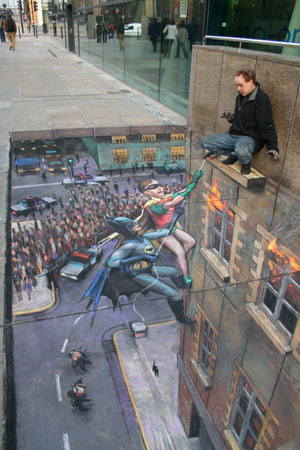
Julian Beever (Representation)
Julian Beever is a chalk artist, who has been creating optical illusions on sidewalks since the 1990s. Known as 'trompe-l'oeil' (or 'trick eye' in french), he creates large drawings which, when viewed at the right angle, look very realistic.
His work is very interactive, and most of the images you'll find have people posing with it. Many of his chalk drawings seem to tear open the sidewalk.
The works are created with a process called anamorphosis, which creates a distorted projection of an image, to be viewed at a certain angle. Leonardo Da Vinci is believed to have been the first person to create anamorphic drawings.
...I still can't seem to post pictures, so these are a couple links to info/pics. You have probably seen his stuff before.
http://www.designsdelight.com/optical-illusions/julian-beever-pavement-art-3d-optical-illusions/
http://hubpages.com/hub/Incredible_Beever
I really like this one..
http://images.cdn.fotopedia.com/flickr-1195257719-image.jpg
he seems to have fun with it..
http://laughingsquid.com/wp-content/uploads/julian_beever_batman.jpg
His work is very interactive, and most of the images you'll find have people posing with it. Many of his chalk drawings seem to tear open the sidewalk.
The works are created with a process called anamorphosis, which creates a distorted projection of an image, to be viewed at a certain angle. Leonardo Da Vinci is believed to have been the first person to create anamorphic drawings.
...I still can't seem to post pictures, so these are a couple links to info/pics. You have probably seen his stuff before.
http://www.designsdelight.com/optical-illusions/julian-beever-pavement-art-3d-optical-illusions/
http://hubpages.com/hub/Incredible_Beever
I really like this one..
http://images.cdn.fotopedia.com/flickr-1195257719-image.jpg

he seems to have fun with it..
http://laughingsquid.com/wp-content/uploads/julian_beever_batman.jpg
Subscribe to:
Posts (Atom)