Saturday, May 1, 2010

Ron Mueck - Annotated Bibliography


Von Herausgegeben, Ron Mueck, Germany: Hatje Cantz Verlag 2005.

This publication of Ron Mueck’s was originally written in German and contains both English and German translation. Heiner Bastian and Susanna Greeves translate these texts. The original author Herausgegeben firstly looks at Mueck’s first exhibition and simply breaks down his work on a visual level. The text contains references to early Greek and Italian paintings, drawing comparisons. The text as a source is extremely reliable as it references other critics and artists, as well as giving an informative opinion. The text helped inform my own opinion of how to view Mueck work in relation to representation and new ideas of realism.


Heartney, Eleanor, Art And Today, London: Phaidon, 2008 94-119

Heartney is an editor of the text Art in America and Art press. Her reliability as a source is upheld through her credentials. Through referencing Heartney cites landmarks in history and technology that informed our ideas of reality. She makes references to ancient Greek philosophers and artists that have defined representation. The text begins by using an ancient story of Greek painters that questions notions of realism. Overall the text was written very well and was well sourced with references showing comparisons of artworks throughout history. By citing our changing view of the world and making the connection that art has to representing our idea of reality I found this text extremely useful.


Tanguy Sarah, ‘The Progress Big Man A Conversation with Ron Mueck’, 2003, 2003, VOL 22; PART 6, pages 28-33, USA (accessed 29th April 2010),
http://api.ning.com/files/bPMJvQlZTLLxzPVE5B21hykyiQBRt*9bjCWLSZkN8FbAkHShUJfnuJRv-1V2dchNpwWM34FbL5YD6xfXjMv*VH1TGpH3nmMv/TheProgressBigManAConversationwithRonMueck.doc
.
Sarah Tanguy is a writer and independent curator based in Washington, DC. This credential is enough to make her a credible source. In the interview, Mueck explains the genesis of Untitled (Big Man) and offers an explanation of his technique and in turn this gives us an insight into is thought process. Tanguy asks very informative questions that helped me realise how Mueck’s work avoids labels of naturalism, realism, and illusionism. Instead this text offers information of the work from the artist’s perspective

Eva Hesse (for Elizabeth L)


Here is the artist I recommend you take a look at:

http://www.hauserwirth.com/artists/34/eva-hesse/images-clips/


Please take a good look and let me know what yo think - I know she will be relevant to your 'bees wax' works!

A.

Wednesday, April 28, 2010

Question

how do i add myself to the members post, on the right hand side of the page?

Art & Representation

What is Representational art?

The word "representational," when used to describe a work of art, means that the work depicts something easily recognised by most people.

However in our class descussion, we touched on the ideas of not only the 'objective view' of representational art but also the subjective. Presuming that an individuals perception, influences, interests ect. will effect the individuals response to representational art in perhaps an emotive fashion. This, we realised to be an important fact due to the recent change in opinion of what can be considered as representational art. As it has moved from purley being, art which aimed to be entirely figurative, a mimic as best as possible of the real. Wheras today what is represented often toys with realities and dimension, eg. the combination of real images or objects with fictional, the use of mirrors, sound, movement, changing the dimensions of an object. ect.


I find that this could be a very interesting topic to research, to discover the different ways in which artist's create representational art and stimutanisously looking into various interpretations of representational art. To discover whether or not these ideas are shared by scholars and other artists.

Tuesday, April 27, 2010


Dario Ortiz
Is a Colombian neo-realistic astist known for his contemporary compositions based on classic subjects. He is a leadin figure of the Renaissance of the contemporary narrative art in Latin America.
His paintings are complex interplays of form in space that document an emotional as well as a physical process and are as disturbing as they are convincing in their reality.

Ji Yong-Ho

Wild Boar Head 2 - 2007, used tire, steel, wood, styrofoam - Gana Art Gallery

Ji Yong-Ho is a South Korean artist who sculpts larger than life animals out of recycled rubber tyres. His studio is filled with hyenas, horses, felines and menacing ram's heads. "My concept is mutation - mutants" he exlpains. The futuristic beasts have earned him a prestigious artists residency and live-in studio through the Gana Art Gallery. To Ji, rubber symbolises mutation as "The product is from nature", from the white sap of latex trees. "But here it has changed. The colour is black. And the look is scary". "Rubber is very flexible, like skin, like muscles". It gives him more freedom to capture the expressivity of the animals, representing for example; the horses wistful glance or the way inwhich the hyena cocks its hind leg.

Ho's concept of mutants grew out of his l8ife in Seoul, where there is fierce political debate over genetic engineering. During school, he studied Darwinism and was immediately glavanised by how his theory of evolution applied to man's manipulation with nature. Already, he says, cats and dogs are bred to emphasize their domesticated traits and downplay their wild sides. The sculptures can be taken as warnings; if we're nto careful, we may soon lose the ability to see animals in their natural state altogether!

Gwon Osang


Gwon Osang, a contemporary Korean artist, who uses hundreds of photographs of his subjuects to create remarkable 3D sculptures. (New form of art called photograhic sculpture). The series called 'Deodroant Type'- Gwon took hundreds of photographs of a single MODEL and layered them over mannequins for a result that is sometimes TRUE TO THE FORM OF THE MODEL, and sometimes ALTOGETHER DIFFERENT, verring into bizarre proportions. Sometimes, the strangeness of the work reveals itself slowly, as you view one fragment at a time. But in others, the deviation from REALITY IS EVIDENT- a man with two tiny heads on his shoulders, or two torsos attached to a singler pelvis wrestling with each other.


"I BELIEVE THERE ARE TWO TYPES OF PEOPLE, those that really do not believe in the existance of a genius and the other, only denying the existence of a genius to be modest (where in realit, they believe they are the 'genius'. I think I BELONG TO THE LATTER CASE....TO SHOW THAT I HAVE A CERTAIN CONVICTION IN MY WORK..."


Pierre Huyghe


Annotated Bibliography Thomas Demand

Thomas Demand, Presidency 11 2008, Photograph, Thomas Demand VG Bild Kunst Bond


Tamara was given a PHD in 2005 from the University College London. This text talks about the relationship between Thomas Demand, Jeff Wall and Sherrie Levine, and other artists. In particular it justifies the use of photography and its relationship to the body. The article is relatively reliable as the author has discussed views of other artists and art critics, as well as her own opinion. The article helped me with justifying Demands use of photography. However the language used was difficult and I often had to look up words. I would suggest that this article is aimed at people of a high intelligence.

"Thomas Demand". http://www.thomasdemand.de/. (accessed April 28th 2010)

This is Thomas Demand's website. BlauPause a web design company has designed the site. It's focus is on many but not all of Demand's work, including photography, film and installations. The site is created for all ages, as it lacks detail, its purpose is to view Demand's work in detail, due to the clear images. As this is Demand's offical site, it is reliable, dates and titles are all precise. The site would be more helpful with more text, a bibliography of Demand would improve the site. Overall the site was useful as images of Demand's work were hard to find.

Heartney, Eleanor, Art And Today, London: Phaidon, 2008 94-119

Heartney is a cultural Critic in New York city, She is an editor for Art in America and Art press, she has also been a lecture for many universities. This book defines representation, from the beginning to the end; Heartney makes references to philosophers and ancient stories. The second half of the chapter is focused on artists whom have taken a spin on representation. The chapter is easy to understand and aimed at anyone who knows minimal amounts about art. Heartney has copious experience in art and is a reliable source, she incorporates art critics and makes references to other opinions and essays. This Text was very useful in defining representation in terms I could understand, a clear and concise cross section of art is written in the book.

Art and Representation - Babette Mangolte


Looking and Touching
2007

Babette has a number of installations that deal with the viewers sensual perception of the work. 'Looking and Touching (2007)' was an installation that consisted of photographs in frames on the walls, scattered on a table and on computer screens. The idea was that the viewer became aware of the different ways to 'view, feel and touch photographs'. So it is not really what's contained in the photos that's important but the whole viewing experience.
I think these works fit into the catagory because the origional idea of realistic representational pictures was to give people true accounts of events or people, Babettes installation shows the viewer the different aspects of the medium of photography which represent the sensations felt in the presence of the photos. Its interesting because people would become aware of how seeing pictures being displayed importantly on the walls contrasts to seeing them tossed on the table.

Art and Repre

Hyperbolic crochet coral reef


I really enjoyed watching this project come to fruition. One of the three chicks that organised the show lives with me at alpha so not only did I get to see the progression of the show, I also got the low down on the concept straight from the horsies' mouth......and passionate horsies they were. I think this is an interesting example of representation firstly because they used an already processed organic matter to produce the form of another organic subject and also because of the huge commitment to the environment shown throughout the entirety of the process. I think these sort of "eco friendly" works are most certainly the way of the future or at least should be. Another interesting element of this project is that is made up using a "craft" form. Craft is often poo pooed amongst artists and art schollars and sometimes with good reason but i couldnt say a bad word about the Hyperbolic Crohet Coral Reef, it was really magical and I idnt feel like a consumerist jerk while appreciating it.

http://sydneyreef.blogspot.com/

The Uncanniest Valley

Shpinx 2009
Hypothesized emotional response of human subjects is plotted against anthropomorphism of a robot, following Mori's statements. The uncanny valley is the region of negative emotional response towards robots that seem "almost human". Movement amplifies the emotional response.


Hany Armanious is one of Australia's 2011 Venice Biennially representatives.
His works are mainly resin casts.
"Uncanny Valley" is his 2009 show which was at Roslyn Oxley9.
I found this particularly interesting in relation to the platonic notion of art, and the inference that when mimicry and representation near the reality there is an in built human aversion to it.

Art & Representation: Ron Mueck

'Boy' 1999, by Ron Mueck is 5 metres high and made from fibreglass.

'Boy''s Foot.

Ron Mueck's sculptures are hyper-realistic representations of the human form. Mueck plays with the scale of the work and changes it dramatically in order to alter the viewer's sense of space and reality.

The emotion that comes through in the work is palpable. This is because Mueck is able to capture facial expression as well as body language to perfection. In this particular sculpture the audience can easily pick-up on an acute and animalistic fear apparently felt by the subject.

Mueck's works deal with very private and intense emotions and scenarios. It really is a shock to have that kind of intensity of emotion in juncture with the sculptures' proportions.


Monday, April 26, 2010

???

Tash Velkou & Alex White - you both need to indicate which artists you are presenting for the class tomorrow?

This should be done by students prior their presentations (primarily to give me a heads up on the artist you are discussing).

Please add this information today.

Cheers,

Amanda.

Art and Representation: Sylvie Blocher@MCA


Used my public holiday for a good old trip down to MCA to catch the last day of the Blocher exhibition. Deffinitely worth while! There is an incredible intimacy in her work, her subjects seem either entirely un-self-aware, or uncomfortable in a way so as to give a similar semblance of truth or insight. Blocher travels around interviewing individuals from all over the world, sometimes providing biting social commentary on issues like racism, nationalism, and wealth/poverty, and at others merely revealing her own profound humanistic empathy with the people she encounters. In regard to Art and representation, I think she is a key example- her subjects are speaking for themselves, and the video camera doesn't lie, right? But curiously, Blocher has edited her own promptings out of the footage and even the background in which the subjects sit has been replaced by a blank stock image. These people and their responses almost float in a timeless contextual void. But despite these efforts, we still come to question what subjective frameworks are creating this reality..

Sunday, April 25, 2010

Julian Beever (Representation)

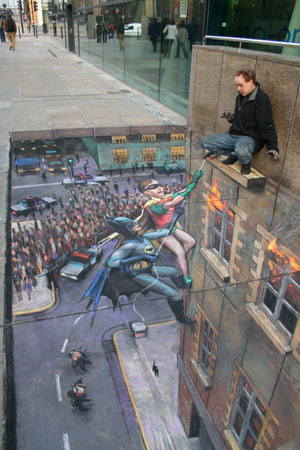
Julian Beever is a chalk artist, who has been creating optical illusions on sidewalks since the 1990s. Known as 'trompe-l'oeil' (or 'trick eye' in french), he creates large drawings which, when viewed at the right angle, look very realistic.
His work is very interactive, and most of the images you'll find have people posing with it. Many of his chalk drawings seem to tear open the sidewalk.
The works are created with a process called anamorphosis, which creates a distorted projection of an image, to be viewed at a certain angle. Leonardo Da Vinci is believed to have been the first person to create anamorphic drawings.

...I still can't seem to post pictures, so these are a couple links to info/pics. You have probably seen his stuff before.

http://www.designsdelight.com/optical-illusions/julian-beever-pavement-art-3d-optical-illusions/

http://hubpages.com/hub/Incredible_Beever

I really like this one..
http://images.cdn.fotopedia.com/flickr-1195257719-image.jpg

he seems to have fun with it..
http://laughingsquid.com/wp-content/uploads/julian_beever_batman.jpg

Friday, April 23, 2010

PRESENTATIONS

Hi there - I hope you all enjoyed your personal feedback sessions this week with Michael... We are back into our class presentation series from next week -

ART & REPRESENTATION: Tash Velkou / Alex White
ART & NARRATIVE: Nick Dorey / Fiona Dorrel
ART & TIME: Nick Maurer / Rececca Naughton / Hanadi Saleh
ART & NATURE & TECHNOLOGY: Karina Wikamoto / Kendall Oleary / Gwen Rogers
ART & DEFORMATION: Joy Liu

Elizabeth Cha & Isabella Pinto PLEASE email me ASAP to confirm the Topic Area you will be presenting.

8

26 April

27 April

ART & REPRESENTATION

9

3 May

4 May

ART & NARRATIVE

10

10 May

11 May

Gallery Visit / Screening

11

17 May

18 May

ART & TIME

12

24 May

25 May

ART & NATURE AND TECHNOLOGY

13

31 May

1 June

ART & DEFORMATION

Conclusion + Essay due

hmmm

double checking i'm doing Art and Representation this Wednesday.....

Monday, April 19, 2010

Another Kate Murphy

What is apparent upon first entering the gallery is the sparseness of the hang followed by the solitary voice of 'The Notes' narrator from the next room. This feeling of absence pervades the space along with the film work and is a beautiful analogue to the physical and emotional absence associated with loss. 'The Note' is the suicide letter of one of Murphy's distant relatives and the core for this exhibition.

The sound from the 10 minute single channel video work haunts the almost absent white cube style gallery and you are confronted with a single portrait devoid of its subject. In focus an old birdcage style microphone in front of a dark theater and a sea of empty seats. In the reflection of the glass the viewer experiences themselves alone on stage the same stage as 'The Notes' reimagined protagonist.

The solitary female figure stands on a stage addressing a nonexistent or imaginary audience with her back to camera her face never seen. The banality of her words is quite disconcerting and is so specific and personal that it at least at first glance, seems inaccessible to any but those who knew him/her. A pattern emerges between sung verse and spoken soliloquy, it becomes painfully apparent that the writer of 'The Note' was a very isolated person, as he/she appreciatively tallies and gives thanks to the few meager fragments of kindness to which he/she had clung. There is an almost hymn like quality to this song and at points we are not sure if we are observing a prayer or a final goodbye . A myriad of faceless characters are mentioned including the protagonist's doctor, who is expanded to become the subject of a fictitious therapy session and Murphy's other video work in this show. In the composition Murphy seems to embed a cross between the spotlights and the central character, this echoes the martyr like resignation to fate of our protagonist.

Upon the farthest gallery wall hangs the score to 'The Note' almost an artifact of the missing, this is then followed into the office space of the gallery and the illusion of absence is shattered. The remaining two photographic works take on a postcard quality and when thought of in this cluttered context and are simply out of sync of the shows greater thrust. This undermines to some degree the power of the rest of the show.

There is a lovely dark humanity in this work, especially the central video piece and the overall sensations associated with loss, place this work as a somber requiem to the many especially in the Australian society who have been affected by the loss born of suicide.

Monday, April 12, 2010

Kate Murphy "The Note"

Upon entering Breen Space it was not apparent to me at all that I would be leaving overwhelmed by an existential crisis! My first impressions of the space are clean, white, sparse professional gallery. There is little hung in the main space and the room in which the projection is screened is neatly tucked away behind a swish black curtain (the predominance of my gallery experience thus far has been artist run spaces…..although they have an undeniable charm).

The projection room is of good proportion to the screen and the room was private and quiet. This means something to me as I believe when watching a video or projection it is imperative for the viewer to be able to focus without interruption. In particular for a work like the one I was about to experience.

Without having read anything relating to the work previously, after only a few moments I was able to detect the sentiment intended. I’m not sure if this was because of my personal challenges with the topic ( I have lost a friend in the same fashion recently) or if it was the sombre and engaging tone of the piece.

Although having mentioned the qualities of the tone of the work, the presentation of “The Note” was surprisingly effective. A theatre that somewhat resembled a primary school assembly hall and a woman in a puce dress with an almost melodramatic theatrical voice instantly called on memories of uncomfortable and boring ( I might go as far to say cheesy…..sorry Kate) nights spent at suburban school plays. Alas, as soon as I let the words themselves sink in to my mind I was totally and emotionally enveloped. The writer of the note being an individual delivering themes that could extend to almost anyone, the score and song representing a universally embraced vehicle for emotional projection and last but making possibly the most important statement for the artist was the faceless body of the voice and absent audience. Wandering out into the main area of the gallery bleary eyed, the almost vacant walls in the main space, inhabiting only two stills from the video, become ever so apparent.

“The Note” has stayed with me since that day and has reminded me to have patience with what may not seem so appealing on first glance. It has reminded me to look beyond the exterior and aesthetics that I may disapprove of because there could be something far more important hiding behind them.

Woah, heaps emotional hey! But, that’s the reaction I got and I think this would be a success in the eyes of the artist!